
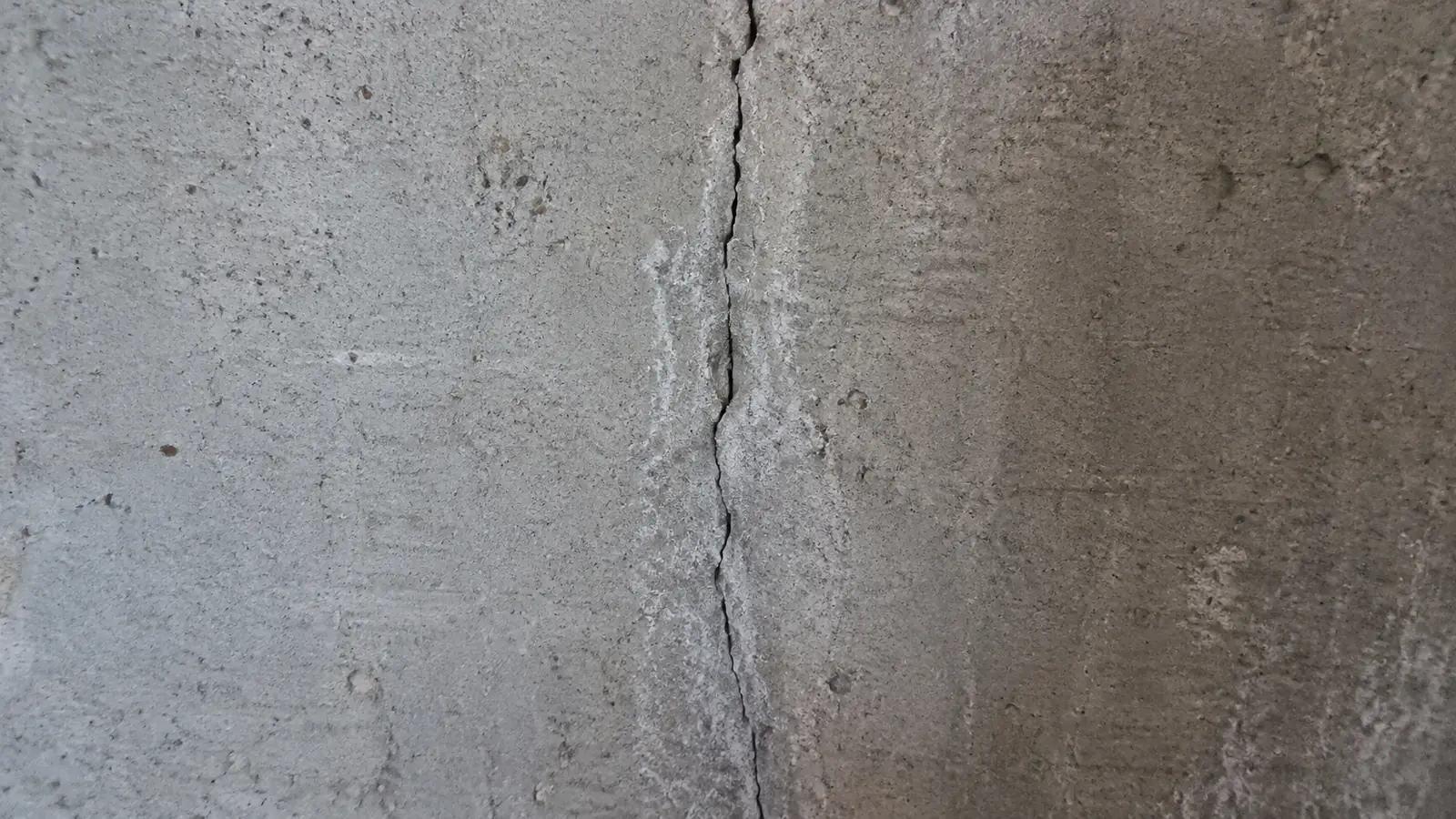
Most cracks in a basement wall are not a structural problem, and saying so up front is more useful than anything else on this page. Concrete shrinks as it cures and keeps moving with temperature for the life of the building. A house settles into its ground in the first years and then mostly stops. A large share of the cracks people find with a torch on a Sunday afternoon are the record of something that already happened and is not still happening. What matters is which kind you have, and the shape, direction and location of the crack tell you most of it.
Poured concrete and block crack in different languages
If your wall is a smooth gray surface with faint horizontal seam lines and small round patched holes at regular spacing, it is poured concrete and those holes are form ties. Poured walls crack in tension, so their cracks tend to be single, narrow, roughly vertical or slightly diagonal, and they often start at a weak point — the corner of a window opening, a beam pocket, the middle of a long unbroken run.
If you can see rectangular units and mortar joints, it is concrete block, and a lot of Kalamazoo’s older housing stock is block or fieldstone. Block does not crack across itself first; it fails along the mortar, which is the weaker material. The result is stepped cracking that runs diagonally from joint to joint like a staircase, or a horizontal separation along one continuous bed joint. That difference matters enormously, and it is the reason a photograph of a wall is worth more than a description of one.
The ones you can reasonably watch
A vertical or near-vertical crack in poured concrete, hairline to about the width of a credit card edge, the same width top to bottom, dry, with no offset when you run a finger across it — that is shrinkage. It is cosmetic. If it does not leak, it does not need work, and you are entitled to be told that.
Fine stepped cracking in block mortar at a corner, with no bulge and no displacement, is usually settlement that has finished. Hairline cracking radiating from the corners of a basement window is stress concentration at an opening, not foundation movement.
The honest test is time, not opinion. Pencil a line across the crack, write the date on the wall, and measure the gap with a ruler. Photograph it. If it has not changed in six months across a Michigan winter and a Michigan spring, it is not active and you can leave it alone.
The ones that need someone out this week
A crack that is wider at one end than the other, especially wider at the top, means one part of the wall or footing is rotating or dropping relative to another. A crack where the two faces are no longer flush — one side stands proud of the other — means the wall has moved out of plane, not just apart. Stepped cracking in block accompanied by any inward lean at mid-height is the beginning of a wall failure and belongs on our bowing basement wall page. And a crack running horizontally along a block bed joint is a different animal altogether, driven by soil pressure rather than shrinkage; read horizontal crack in a basement wall before you do anything else. Those are load problems. They get worse, and they get more expensive the longer they run.
Doors upstairs that have started sticking, a gap opening between a wall and a ceiling, or cracking that reappears in the same place after being patched twice all argue for a look sooner rather than later.
Why Kalamazoo cracks widen when southern ones do not
Water enters a crack. It freezes. It expands by about a tenth of its volume, and because it has nowhere to go but outward it prises the crack a little wider. It thaws, more water gets into the slightly larger gap, and the cycle runs again — not once a winter but every time the temperature crosses freezing, which here is dozens of times between November and April. That is freeze-thaw, and it is why a crack that has been quietly weeping for two seasons is measurably wider now than it was. It is also the strongest argument for sealing a leaking crack even when it is structurally harmless. Left open, it does not stay the size it is.
What repair is and what it costs
For a non-structural crack in poured concrete that leaks, the standard fix is injection: a low-viscosity epoxy or expanding polyurethane pumped through ports into the full thickness of the wall so it seals front to back rather than skinning over the face. Commonly $400–$900 per crack in this market. Urethane is the usual choice where the crack is wet and may still move slightly; epoxy where the priority is bonding the concrete back together. Surface patching with hydraulic cement alone tends to fail, because the water pressure behind it has not gone anywhere.
Block walls cannot be injected the same way, since the cavity behind the face shell simply carries the resin off. Leaking block is normally handled by controlling the water instead, and structural block cracking is handled with carbon fiber straps at roughly $600–$1,000 per strap or, in worse cases, steel beams or wall rebuilding.
What we do about it is set out on our foundation crack repair page, and the wider price picture is on the cost page. If you are unsure which category yours falls into, photograph it straight on with something for scale in the frame and have it looked at. Being told it is nothing is a perfectly good outcome.