
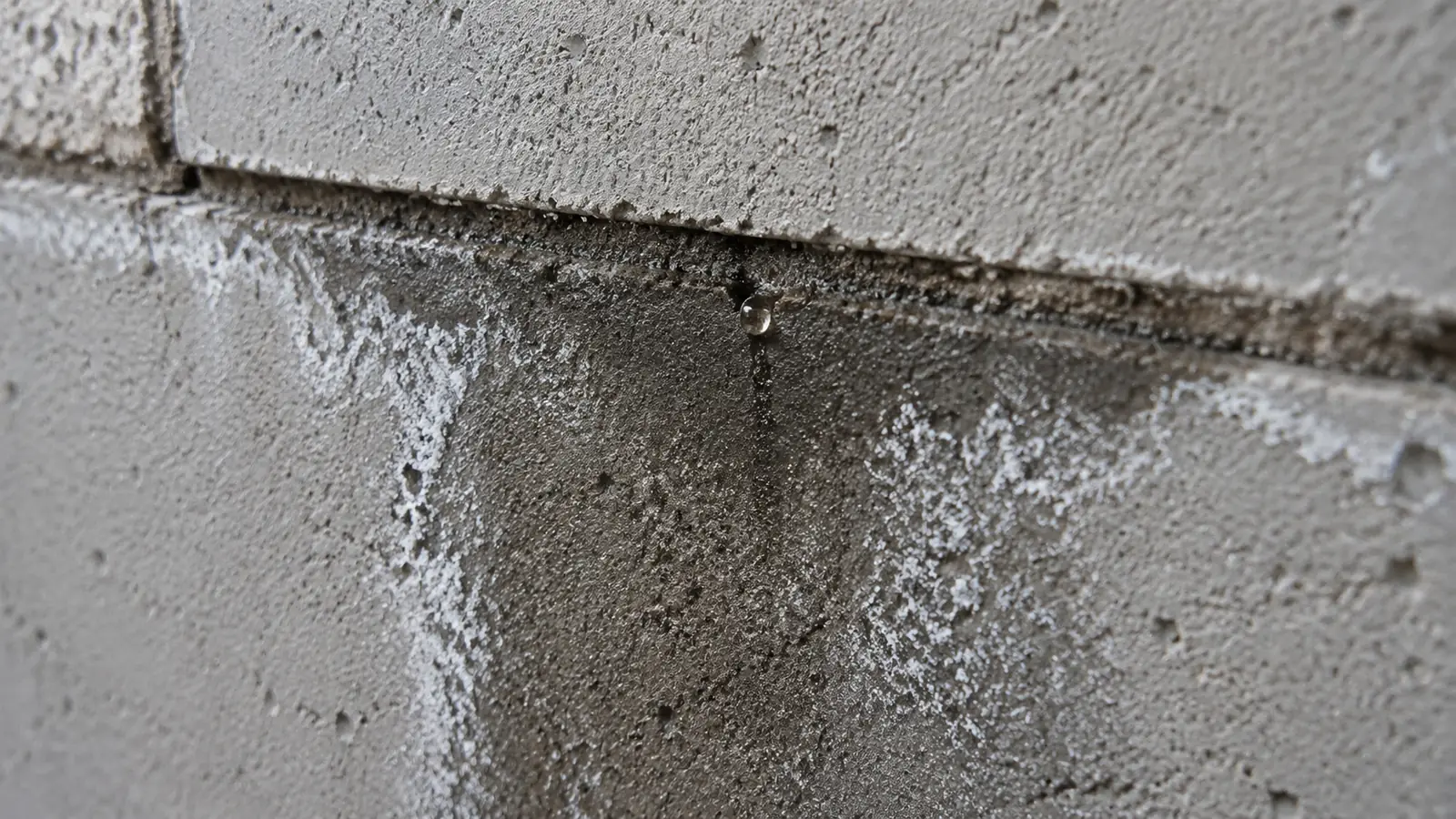
A leaking wall is better news than a seeping one, at least diagnostically. A leak has a route — a single opening water is traveling through — and a route can be found and closed. Damp spreading through the body of the masonry is a harder problem than water running from one identifiable point. So the first job is to find the point, and the second is to work out how high up it is, because that single fact changes the price by an order of magnitude.
Find the top of the wet mark, not the bottom
Water runs down, so the puddle on the floor tells you almost nothing about where it came in. The highest point of the wet streak is the entry. Get a torch, hold it flat against the wall so the beam rakes across the surface, and follow the stain upward until it stops. That is the spot.
If the trail starts above the outside ground level, the water never came out of the soil at all. It came over the top or through the wall above grade — a gap at the rim joist, an unsealed hose bib penetration, a window frame with failed caulk, a brick veneer above with no flashing or blocked weep holes, or a dryer vent cut through the wall and never sealed. These are the cheapest leaks there are, often fixed for the cost of a tube of sealant and an hour on a ladder, and they are missed constantly because everyone assumes a basement leak is a groundwater leak.
If the trail starts below the outside ground level, you have a below-grade leak and the rest of this page applies.
The usual routes in a poured wall
Poured concrete is solid, so it leaks at defects rather than through itself. The commonest are form tie holes — the small round patched marks in a regular grid across the wall, where the plug has shrunk or fallen out — and cracks, most often vertical or slightly diagonal, running from a window corner or a beam pocket. Add to that the sleeve where the water service or sewer passes through the wall, which is frequently the single wettest point in an otherwise dry basement.
A leaking crack in poured concrete is usually a good outcome. If it is a consistent width, flush across its faces, and not widening, it is a shrinkage crack that happens to be wet, and that is an injection job rather than a structural one. Our page on basement wall cracks sets out how to tell that from a crack that is actually moving.
Why block walls leak differently
Concrete block is hollow, and that changes everything. Water getting past the outer face runs down inside the cores and collects there, so the wall becomes a reservoir before it becomes a leak. It then emerges wherever the inner face is weakest, which is normally along a mortar joint or at the bottom course where the wall meets the floor. Much of Kalamazoo’s older housing stock is block or fieldstone, so this is a local pattern rather than an exotic one.
The tell is timing and spread. Block leaks tend to start hours after the rain rather than during it, run along a joint rather than down from a point, and continue for a day or two after the weather clears — because the wall is draining itself. Fieldstone and rubble walls leak through the mortar between stones in much the same way, and there is no single point to seal.
If the wet area is a spreading darkness with no traceable line at all, it is seepage rather than a leak, and water seeping through a basement wall is the closer match.
How worried to be
A leak by itself is a water problem, not a structural one, and the wall is not about to fail because it is wet. Take it more seriously if the crack it is coming from is wider at one end than the other, if the two faces are offset, or if the leak is at a horizontal joint in a block wall — that last combination points at soil pressure rather than plumbing-grade water, and it is worth a proper look.
Do not leave a leaking crack open on the assumption that it is only cosmetic. Water sitting in it freezes through a Kalamazoo winter, expands, and levers the crack a fraction wider each cycle, and the cycles run dozens of times between November and April. A leaking crack this spring is genuinely a slightly larger leaking crack next spring. That is the argument for sealing it even when nothing structural is at stake.
What each fix runs
Above-grade sealing, window and hose bib work: tens to a few hundred dollars. Downspout extensions and regrading so less water reaches the wall in the first place: a few hundred to about $2,000, and worth doing before anything more ambitious.
Injection of a leaking crack in poured concrete with epoxy or polyurethane commonly runs $400–$900 per crack and is a permanent repair when the crack is stable. A failed tie hole is cheaper still, plugged and sealed.
Block walls cannot be injected the same way, because the resin disappears into the cores. Water in a block wall is normally handled by interior basement waterproofing — drainage at the footing, a sump, and the bottom course weep-drilled so the wall can empty into the drain rather than through your paint. A full perimeter system commonly runs $8,000–$15,000 on a typical house here, and a single wall considerably less. Excavating and membraning the outside is $15,000–$30,000 and up, and is the right call less often than it is proposed.
The cost page sets out what actually moves those numbers. Before you call anyone, find the top of the stain and take a photograph of it — that one piece of information saves an hour of guesswork.