
This is the structural end of the trade and it is the expensive end. Everything else on this site is about water. This page is about a wall that is losing an argument with the soil behind it, and the difference matters, because a wet wall is an inconvenience and a moving wall is a building problem that gets worse rather than better.
The load is real. Saturated soil against a foundation wall pushes laterally, and clay till — which runs in bands all through this county — pushes harder because it swells as it takes on water. Add freeze-thaw working at the top few feet of the wall every winter, add a wall of unreinforced block, which is how a great deal of older Kalamazoo housing stock was built, and you have the standard local failure: a horizontal crack along a mortar course somewhere near mid-height, and the wall above it leaning in.
What tells you a wall is structural rather than cosmetic
A horizontal crack is the signal. Vertical shrinkage cracking in poured concrete is ordinary. A horizontal crack is a bending failure, and it means the wall has hinged. A stair-step crack through block mortar joints, particularly one that is wider at one end, is the same story told diagonally.
Bowing you can measure. Hold a string line from the top of the wall to the floor and look at the gap at mid-height. An inch is a wall that needs watching and probably reinforcing. Two inches or more needs engineering attention, not a product recommendation. If block courses have slid sideways relative to one another, or you can see daylight, that is an emergency and the basement should not be occupied.
The bowing basement wall and horizontal crack pages go through the diagnosis in more detail.
Carbon fiber straps
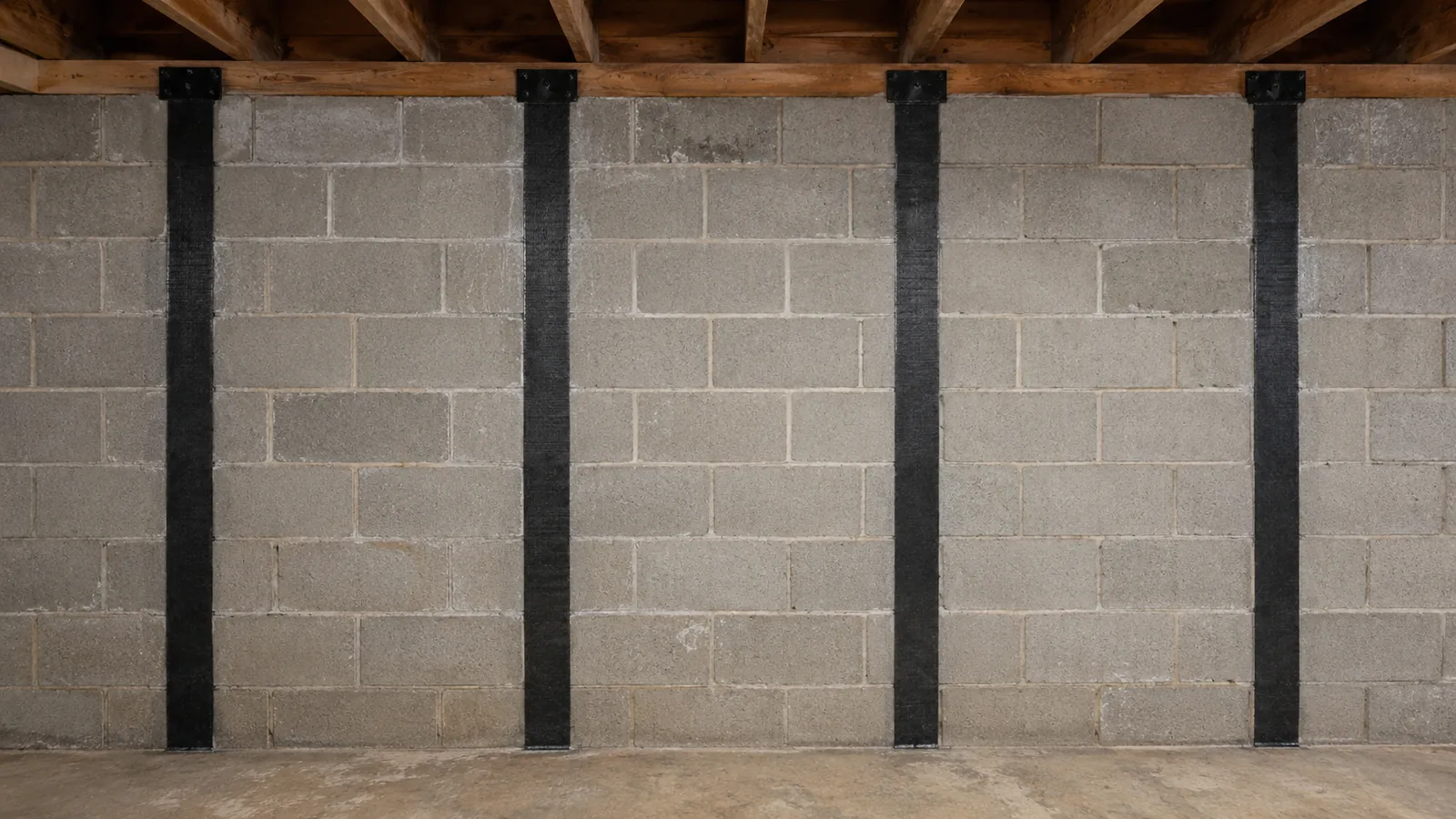
Vertical strips of carbon fiber fabric bonded to the inside face of the wall with epoxy, anchored into the floor slab at the bottom and into the sill or joist framing at the top. The material is astonishingly strong in tension, which is exactly the force a bending wall is failing in, and the installation is clean — no excavation, no yard damage, straps sit flush and can be painted or covered.
They hold a wall where it is. They do not straighten it. Carbon fiber is the right answer for walls with roughly two inches of deflection or less that are not still moving fast, and it is by far the least disruptive option. In this market straps commonly run $600 to $1,000 each, installed at four to six foot centers, so a single 30-foot wall is often $4,000 to $6,000.
Steel I-beams
Vertical steel members set against the inside face, seated in a pocket in the floor and braced at the top against the floor joists — which sometimes requires blocking or a new sill plate to give the beam something honest to push against. Beams handle more load than straps and can be used on walls that have deflected further.
Some systems are adjustable and can be tightened over a season or two to take a wall back toward plumb. That works, when it works, but it is a matter of months and small increments. Beams intrude into the room — you lose four to six inches along the wall — and they are visible. Costs commonly run $500 to $900 per beam installed, with more beams needed than straps on the same wall.
Wall anchors
Steel plates on the inside face, connected by threaded rods to earth anchors buried out in the yard beyond the zone of soil pushing on the wall. Tightening the rods pulls against stable ground, and over successive seasons — when the soil outside is soft in spring — the wall can genuinely be drawn back toward plumb.
This is the option that recovers position rather than just arresting movement. It needs yard: usually eight to twelve feet of clear ground on the outside of that wall, which rules it out where a driveway, a neighbor’s line or a patio is in the way. Anchors commonly run $700 to $1,200 each installed.
Excavation, rebuild, and the honest top end
Sometimes the wall is beyond reinforcement. Block that is crumbling, a stone foundation whose mortar has gone, deflection past three or four inches, or a wall that has sheared. Then the answer is to excavate outside, relieve all the pressure, and either rebuild the wall in reinforced sections or straighten and rebuild it wholesale, with the house temporarily supported while that happens.
This is a five-figure job and frequently well into it — a single wall commonly $20,000 to $50,000 depending on length, depth and what has to be supported. It is also the only opportunity you will ever have to waterproof that wall properly from outside while the trench is open, which is why exterior waterproofing is almost always done at the same time. Doing it twice costs far more than doing it once.
When you do not need this
A vertical crack in a poured wall is not a structural repair. It is an injection job and it costs hundreds, not thousands — see foundation crack repair. Plenty of homeowners are quoted straps for cracks that never needed them.
A wall bowed an inch that has not moved in twenty years may need nothing but monitoring and a serious effort to keep water out of the soil behind it, since the load is water-driven. Downspouts, grading and drainage reduce the force on the wall. That is the actual mechanism, not advice dressed up, and it is why a good structural contractor asks about your gutters.
Before agreeing to anything, mark the crack ends with a pencil and a date and take a string-line measurement. Do it again after the spring thaw. A wall that is not moving buys you time to decide.
What to ask before you sign
Ask for the measured deflection, in inches, at mid-height, written down. Ask what is expected to happen to the wall after the repair — held, or straightened, and over what period. Ask whether a licensed structural engineer has looked at it, and on anything past two inches insist on one who is not employed by the contractor. Ask how the top of the repair transfers load into the floor framing, because a strap or beam anchored to nothing solid is decoration.
And ask what is being done about the water and soil pressure that caused it, because a reinforced wall with the same load still on it is a wall you have paid to hold rather than a problem you have solved. The cost page sets out how these numbers sit alongside the waterproofing side of the work.