
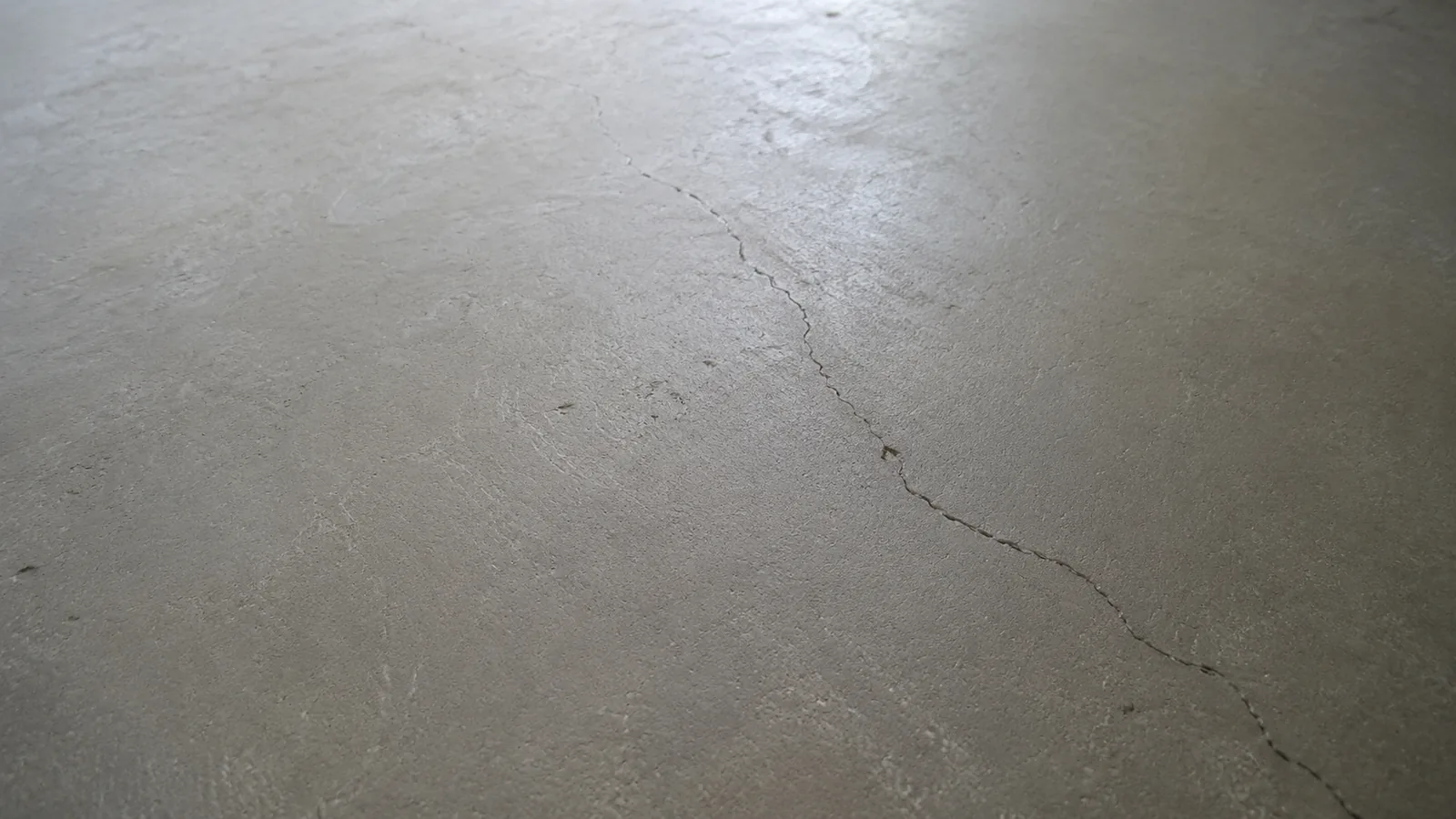
The most useful thing to know about basement floor cracks is that the floor is not holding your house up. A basement slab is typically four inches of concrete poured over gravel after the walls and footings are already in place. It carries itself, the furnace, and whatever you put on it. It is not tied into the structure and it is not load-bearing, which is why a crack in it means something very different from a crack in a wall. Nearly every basement slab in Kalamazoo has cracks in it. Most of them are the concrete’s own business and nothing to do with the foundation.
Why slabs crack almost as a rule
Concrete shrinks as it cures — a few millimeters over every ten feet — and a slab poured in one continuous piece cannot shrink without tearing somewhere. Unless the pour was scored with control joints to decide where that tear happens, it happens wherever the slab is weakest. That produces the pattern you probably have: thin, meandering cracks with no vertical step between the sides, often running out from a corner, a column base or a drain, sometimes crossing the whole floor.
The gravel underneath settles a little as well, especially where the ground was disturbed during construction and never compacted properly — around the footing trench, over a backfilled utility run, under an addition. Slabs also lift and drop very slightly with moisture in the soil beneath, and in this climate the ground under an unheated corner can hold frost against the edge of the slab.
Which cracks are cosmetic
Run your fingers across the crack. If the two sides are flush — no lip, no step — and the crack is roughly the width of a coin edge or less, dry, and the same width along its length, it is shrinkage. It does not need repair. It will not spread through the house. Filling it is a matter of taste and dust, not structure, and anyone treating it as an emergency is overselling.
Hairline cracking radiating from a support column base, or a straight crack that follows a scored control joint, is the slab doing exactly what it was meant to do.
Mark the ends with a pencil and date them. Concrete that has finished shrinking does not carry on. If the marks still bracket the crack a year later, you have your answer.
Which cracks are worth a look
Three signs change the picture.
The first is displacement. If one side of the crack sits higher than the other by more than a knife-blade’s thickness, or if a straight edge laid across the floor rocks, the slab is no longer supported evenly. Something under it has washed out, settled or heaved. That is worth investigating, mostly because the cause — a leaking supply line, a broken drain, fill that was never compacted — is more of a problem than the crack.
The second is water. Water arriving up through a floor crack, or seeping in along the joint where the floor meets the wall, is the slab being pushed on from below by a saturated water table. In the Kalamazoo River valley and low-lying neighbourhoods, where groundwater sits high and comes up further with the spring thaw, this is common and it is a drainage question rather than a concrete one. It belongs with the rest of the pattern described on our page about water in the basement.
The third is company. A floor crack that runs to the base of a wall which is itself cracked, leaning or stepped is not an independent event, and the wall is the thing to worry about. If the wall has a horizontal crack in it, read horizontal crack in a basement wall and treat that as the priority.
Freeze-thaw and why an open crack does not stay put
Once a crack in a slab is passing water, Kalamazoo’s winter starts working on it. Water in the crack freezes, expands, and prises it fractionally wider; it thaws, takes on a little more water, and does it again. Across dozens of cycles between November and April, a wet crack widens in a way a dry one never does. Slab edges near an unheated garage wall or a walkout are where this shows first, as spalling and crumbling along the crack rather than a clean line.
What it costs to do something about
A dry shrinkage crack you simply want closed can be filled with a semi-rigid polyurea or an epoxy paste for the price of the material and an afternoon, and there is no shame in leaving it alone instead.
A crack that leaks is normally handled as part of managing the water, not on its own. Injection through the slab commonly falls in the same $400–$900 per crack band as wall injection, but sealing the top of a crack that groundwater is pushing through often just moves the water to the next weak point. Where the water table is the cause, the honest answer is a sump and drainage — commonly $8,000–$15,000 for a full interior perimeter system on a typical house — and the figures behind that are broken down on the cost page.
Slab settlement over voided fill is usually addressed with injected polyurethane foam to fill the void and lift the concrete, priced by the volume of foam it takes, which nobody can know before drilling test holes.
If yours is dry and flush, you can stop reading. If it is stepped, leaking, or paired with a wall that is moving, our foundation crack repair page explains what an inspection actually looks at and what gets ruled out first.