
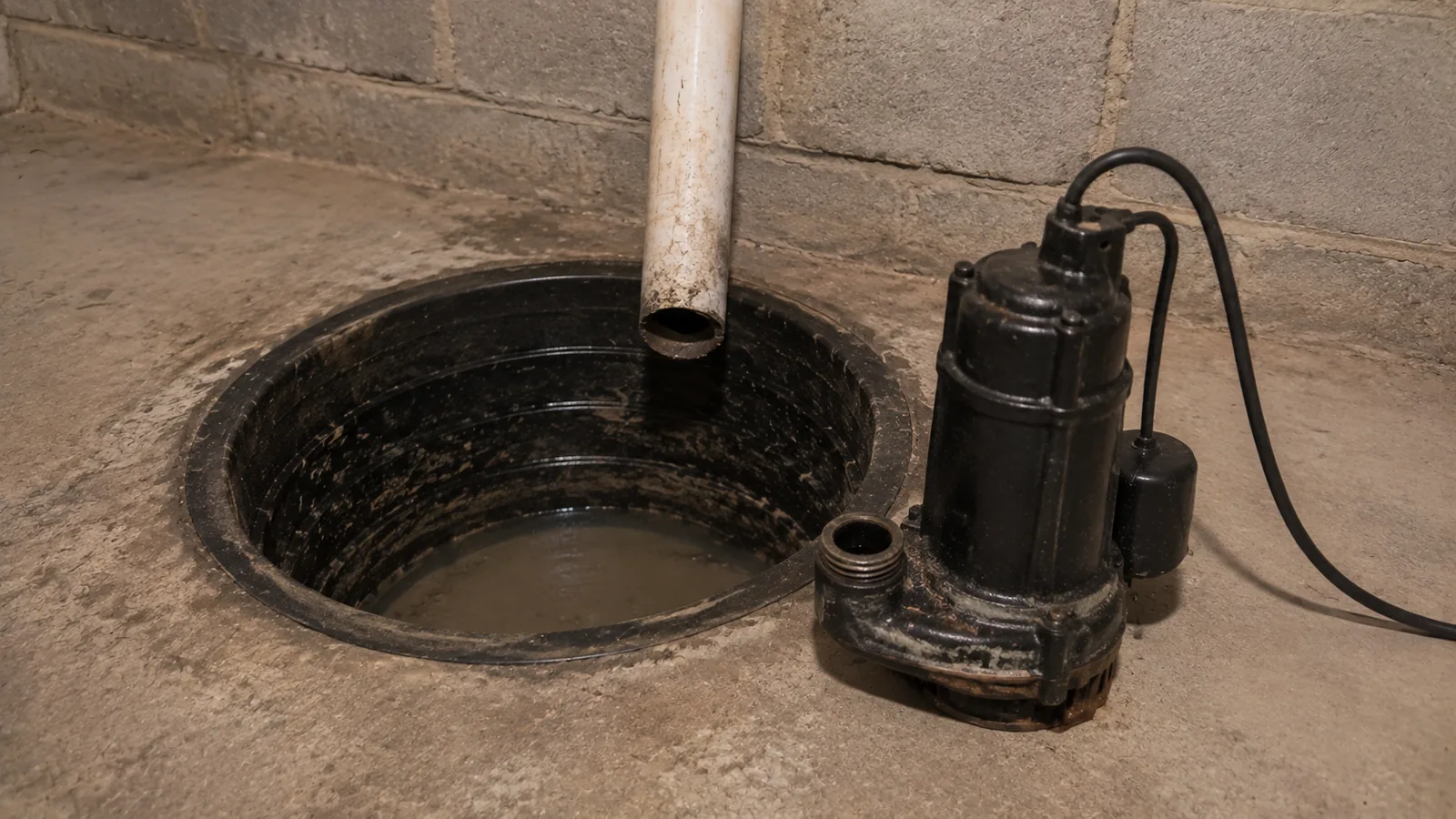
A sump pump that is not doing its job is failing in one of a small number of specific ways, and they look almost identical from the top of the stairs. Water on the floor tells you the system did not keep up. It does not tell you whether the motor is dead, the float is jammed, the impeller is blocked, the check valve has failed, the discharge is frozen, or the pump was simply never large enough for the water this house produces. Those have prices ranging from nothing to several thousand dollars, so it is worth spending ten minutes on the diagnosis.
Start by working out what it is doing
Four states, and each points somewhere different.
Silent, with water in the pit. No power, dead motor, or a stuck switch. Check the outlet first — sump pumps are commonly on a GFCI circuit and a tripped GFCI is the single most frequent cause of a pump that has stopped. If there is power at the outlet, lift the float by hand. If the pump runs when you lift it, the switch is the fault and the pump is fine.
Running and not moving water. The motor hums or runs but the level does not drop. This is an impeller blocked with silt or stone, a broken impeller, an airlocked pump, or a discharge line obstructed — in winter, frozen.
Running constantly and never shutting off. Either the switch is stuck closed, or the check valve has failed and the pump is recycling the same column of water back into the pit each time it stops, or the inflow genuinely exceeds the pump.
Cycling on and off every few seconds. A pit that is too small, a float set too tight, or a failed check valve. Short cycling is what destroys pumps, so this one is worth fixing even though the basement is dry today.
The four common failures, and what each actually costs
The switch. By some distance the commonest failure. A tethered float catches on the pit wall or on the discharge pipe and either never rises or never falls. A pressure switch fails closed. Switches are cheap and a switch replacement is often under a couple of hundred dollars, but on many sealed pumps the switch is integral and replacing it means replacing the pump.
The impeller. A pit with no liner, or one taking sediment out of a drain line, will eventually feed sand and stone into the volute. The pump runs and pumps nothing. Sometimes it is a matter of clearing a blockage. If the impeller vanes are worn or a piece has broken away, the pump is done.
The check valve. A cheap part with a large effect. When it fails, water that was lifted up the discharge falls straight back down into the pit when the pump stops, so the pump restarts on its own backwash. You hear it as a clunk after every cycle and see it as a pump that runs far more often than the weather justifies. A check valve is inexpensive and replacing one is a short job.
The pump that was never right. Not a failure at all. A one-third horsepower pump on twelve feet of head with a long horizontal run may be moving less than half its rated flow, and if the house sits over a high water table it will lose the race every April. Nothing is broken. It is undersized, and no repair fixes that. The installation page covers sizing and head properly.
When repair is money after bad
Replace rather than repair when the pump is past roughly seven to ten years old, when the failure is the motor or the impeller rather than an external switch or valve, when the body is plastic and the repair cost is more than half a new cast iron pump, or when the pump has been short cycling for a long time and has effectively been run to death regardless of what visibly failed.
Replace it also when the diagnosis is that it is undersized, because a rebuilt undersized pump is an undersized pump. And treat any pump that has run submerged in a flooded basement as suspect afterwards even if it still turns.
Where repair does make sense: a good cast iron pump under five years old with an external float or a failed check valve, a frozen or blocked discharge line, or a tripped circuit. Those are ordinary maintenance and should not turn into a replacement quote.
The failures that are not the pump at all
Two situations get misdiagnosed constantly.
A frozen discharge line in January means a perfectly healthy pump running against a plug of ice. The pump gets blamed, replaced, and the new one fails the same way the following winter, because the fault is a line that holds standing water and freezes rather than draining.
And a pump keeping up perfectly while the basement is still wet means the water is not reaching the pit. Water entering through a crack in the wall halfway up, or seeping through block above the drain line, runs across the floor and gets to the pump last. If that is your pattern, look at why the wall is leaking rather than at the pump, and read the water in the basement page for the wider set of causes.
What repair and replacement cost in this market
A service call for diagnosis commonly runs $100 to $200 and is often credited against the work. A check valve or an external switch replacement is usually a couple of hundred dollars including labor. A full pump replacement in an existing pit commonly runs $400 to $1,200 installed, cast iron at the upper end and builder-grade plastic at the lower. Adding a battery backup at the same visit commonly adds $800 to $2,000, and doing it on one trip is cheaper than two.
If the diagnosis turns out to be that the pit is in the wrong place, or that there is no perimeter drain feeding it, you are into a different conversation — see the cost page.
What to ask before you agree to anything
Ask what specifically failed, and expect a component, not a verdict. Ask whether the switch is serviceable separately on your pump. Ask whether the check valve was checked, because it is cheap and it is often the whole story. Ask what the pump’s flow is at your actual lift if the recommendation is replacement.
And ask what the discharge line looks like outside, before anyone quotes a new pump in January. More than one homeowner in this town has bought a pump that was never broken.