
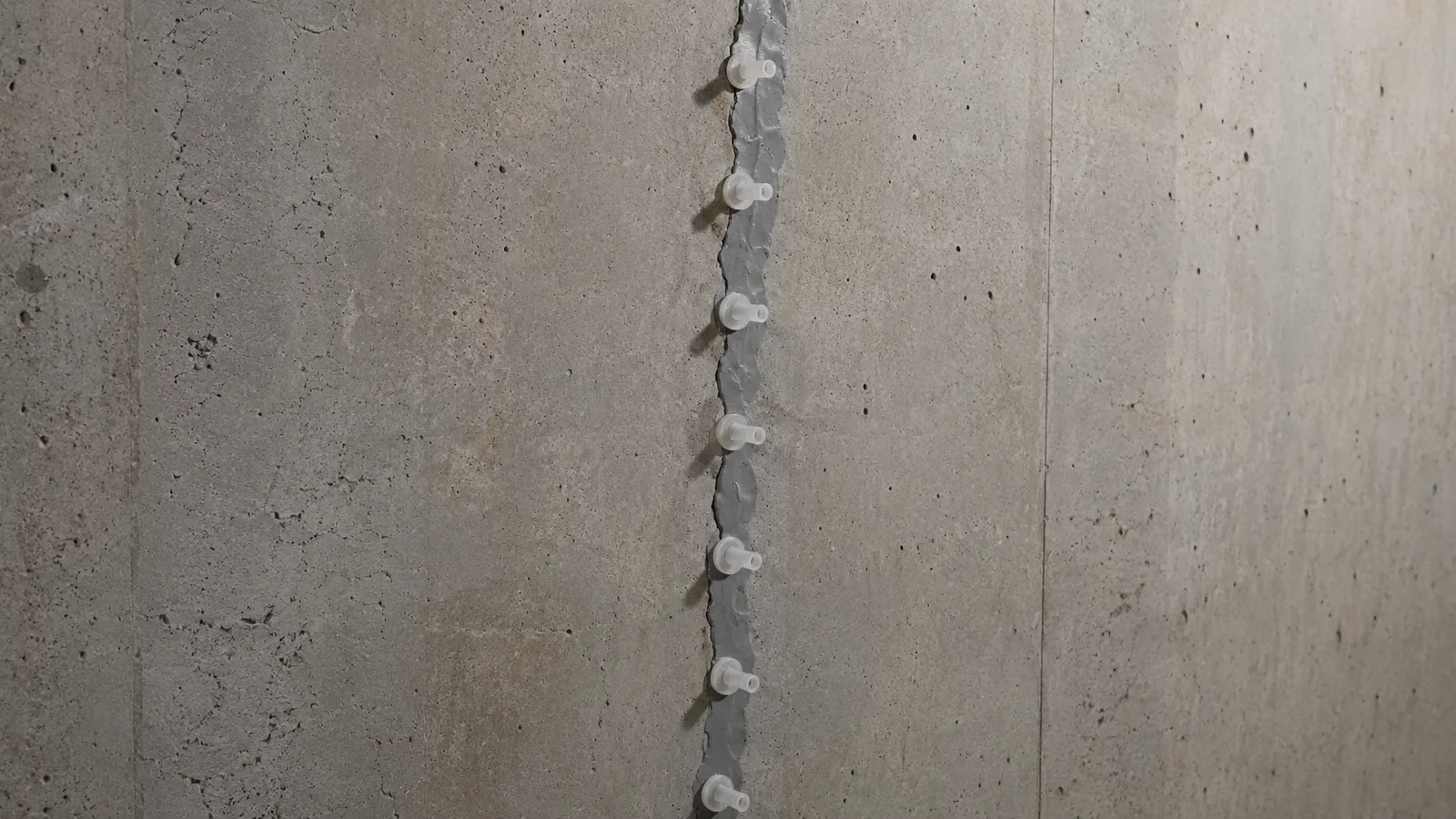
Crack repair in a poured concrete foundation means injection. A port is fixed over the crack, the face is sealed, and a two-part resin is pumped in under pressure until it has filled the crack through the full thickness of the wall — eight or ten inches, not a skim on the inside face. Done properly it is a permanent repair to that crack. Done as a surface patch with hydraulic cement, it fails, usually within a season, because the water is arriving under pressure from the far side and a patch on the near side is being pushed off.
Two resins are in normal use and they are not interchangeable.
Epoxy or polyurethane
Epoxy cures hard and strong — stronger in compression than the concrete around it — and it structurally welds the two faces of the crack back together. It is slow to cure, which is what lets it penetrate the full depth, and it needs a crack that is reasonably dry and clean to bond. Use it where the crack is not moving and where restoring the wall’s continuity matters: a shrinkage crack in a wall that has settled and stopped, a crack you want to stop being a weak line.
Polyurethane is a foam. It is injected as a liquid, reacts with moisture, expands, and cures flexible. It will chase water into a wet crack and fill voids off to the side that epoxy would not reach. It seals. It does not restore strength. Its flexibility is the point: it tolerates a little seasonal opening and closing without cracking through, which in a climate that freezes the ground four feet down every winter is not a small consideration.
The rule most competent contractors work to is simple enough. Actively leaking and wet, or a crack that visibly moves with the seasons: polyurethane. Dry and stable, or a crack where you want the wall knitted back together: epoxy. A wet crack injected with epoxy will not bond, and a moving crack filled with rigid epoxy will simply crack again beside the repair.
Which cracks this actually works on
Injection is a poured-concrete repair. Vertical and diagonal cracks, typically from shrinkage as the wall cured or from minor settlement, are the standard case and the outcome is good.
It is not the right tool on a block wall. Block is hollow units and mortar joints, and there is no single void to inject; water gets into the cores and travels. Block wall leaks are usually handled by drainage and weep holes, or from the outside. The basement wall crack repair page goes into how block and poured walls differ.
It is also worth being clear about floor cracks. A hairline crack in a basement slab is nearly always shrinkage and needs nothing at all beyond sealing if water is coming up through it. The slab is not holding the house up. Cracks in the basement floor explains when one is worth a second look.
The limit, stated plainly
Injection seals water out. It does not stop a wall moving.
If the crack is horizontal, running along the wall at roughly mid-height, that is not a shrinkage crack — it is a bending crack, and it means soil pressure is pushing the wall inward. Filling it with resin makes the basement drier and changes nothing structurally. The wall keeps moving, the repair opens up beside the resin, and the money is gone. The same applies to a stair-step crack in block that is widening, or any crack where one side has moved out of plane with the other.
Those are structural problems, and they are handled with carbon fiber straps, steel beams or wall anchors rather than resin. See basement wall repair for what that involves, and the horizontal crack page for how to tell the two apart before anyone quotes you.
A contractor who offers to inject a horizontal crack and says nothing else is either not looking or hoping you are not.
When you do not need this
A dry hairline crack that has not changed in years, is not leaking, and is vertical, needs nothing. Monitoring it costs nothing: mark the ends with a pencil and the date, and look again in the spring. Most poured walls in this town have one.
Nor does a crack need injecting if the water reaching it is coming from a downspout six feet away. Fixing that outside is cheaper and it may be the whole repair. Water that appears at a crack only in extreme rain, and never in a normal spring, is often telling you about the gutter rather than the wall.
How the work is done
The crack is cleaned back and loose material removed. Injection ports are set along its length at six to twelve inch intervals, roughly matching the wall thickness. The face of the crack between the ports is sealed with a surface paste, which is temporary — it is there to contain pressure, not to be the repair.
Injection starts at the lowest port and works upward. Resin is pumped until it appears at the next port up, which is the confirmation that the crack is filling continuously rather than escaping into a void. That port is plugged and the gun moves up. The whole crack is done this way, bottom to top.
The resin cures, the surface seal and ports are ground off, and you are left with a line. A few hours, not days, and the basement is usable the same day.
What it costs here
In this market injection commonly runs $400 to $900 per crack, with most straightforward eight-foot vertical cracks in the middle of that. What moves the number: length and width, wall thickness, how many cracks are done on the same visit — the second and third are cheaper because the mobilization is already paid — and whether anything has to come off a finished wall first.
If the same visit turns up several leaking cracks and a wet floor-wall joint, you may be looking at a drainage problem rather than a set of individual cracks, and the cost page sets out what that scale of work runs.
What to ask before you sign
Ask which resin they are using and why that one for this crack. Ask whether the injection is full-depth through the wall or a surface treatment. Ask what they think caused the crack, because a crack with a cause that is still active will come back. Ask whether they have looked at the crack’s orientation and whether they consider the wall to be moving.
And ask what the warranty covers and for how long. A full-depth injection on a stable poured wall is a repair a contractor should be willing to stand behind for years, not months.