
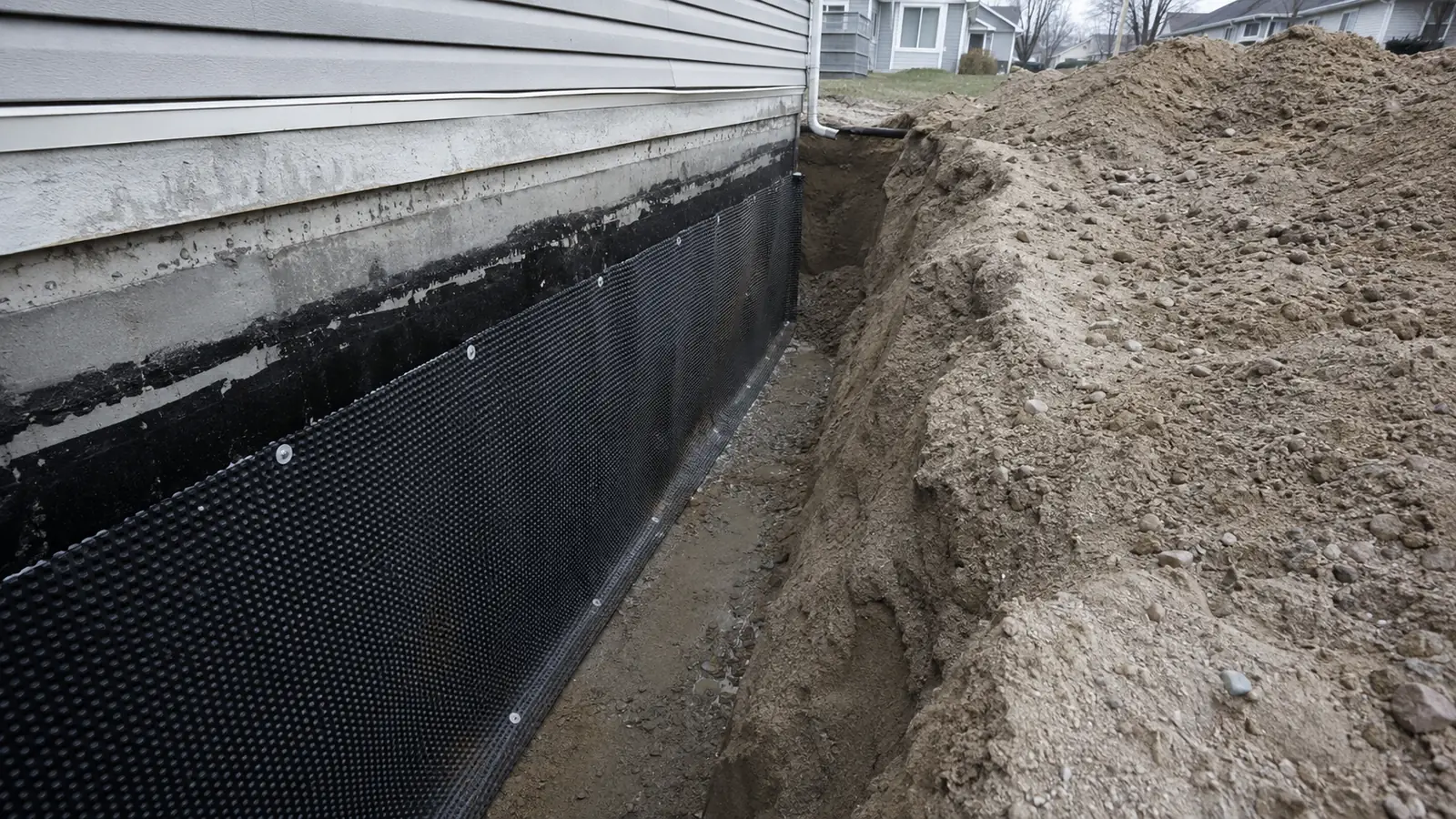
Exterior waterproofing is the version most people picture when they imagine the job being done properly. The soil is excavated away from the foundation wall all the way down to the footing — around seven feet on a full Kalamazoo basement, sometimes more. The wall is cleaned and any failed parging or open joint is repaired. A waterproof membrane is applied to the outside face. A new perforated footing drain is laid in washed stone and wrapped in filter fabric, and the trench is backfilled, ideally with free-draining material rather than the clay that came out of it.
Done properly it stops water at the wall. That is the thing interior drainage cannot do, and it is the reason this work still exists despite costing two to three times as much.
What you are actually buying
Two separate benefits, and it is worth being clear which one you need.
The first is that the wall stops getting wet. A block wall whose cores fill with water every spring, a stone foundation whose mortar is being washed out year by year, a wall where freeze-thaw is working into the outside face — those problems are outside the house, and only outside work reaches them.
The second is pressure relief. Saturated clay till against a foundation wall exerts genuine lateral force, and it is worse here than it sounds because clay swells when it takes on water and shrinks when it dries. If your wall is bowing or has a horizontal crack at a mortar course, excavating relieves the load. It is often the only way to get a wall to move back at all, and it is frequently paired with structural repair, since digging gives access to do both at once. The basement wall repair page covers that side of it.
When you do not need this
Most of the time. That is the honest answer.
If your basement takes water at the floor-wall joint in spring and the wall itself is sound — no bowing, no stepped cracking, no crumbling block — then interior drainage will keep the basement dry for roughly half the money and will not cost you a mature maple, a patio, or the front bed. A damp foundation wall is not by itself a structural emergency. Walls have been damp in this town for a hundred years.
Exterior work also makes no sense at all if the water source is surface water. Regrading and extending downspouts is a few hundred dollars of the same excavation logic applied where it actually pays. Nobody should be digging a seven-foot trench to solve a splash block.
And there are houses where it simply cannot be done. A wall three feet from a property line, a driveway or an attached garage over the trench line, a deck on footings, mature trees whose roots you would be cutting through, or utilities running parallel to the wall. In those cases interior is not a compromise, it is the only option.
How the work is done
A locate is called on utilities first, and on any house with a gas line or service entry along the excavated wall this is not a formality.
Excavation follows, usually with a mini excavator working from one end, spoil stockpiled where it can be reached later. The trench has to be wide enough for a person to work in and stable enough that they can. On sandy outwash ground it will want to slump; on clay it will hold a face but turn to grease in rain. Either way there should be a plan for shoring or benching, and the crew should not be standing in a vertical seven-foot cut.
The wall gets cleaned down to sound material. Failed parging comes off. Open cracks are repaired from the outside, honeycombing is patched, and the footing joint is dealt with. Then the membrane goes on: a fluid-applied rubberized coating, usually, and over it a dimpled drainage board that both protects the coating during backfill and gives water a route straight down to the drain instead of sitting against the wall.
New drain pipe is laid at the footing in washed stone with fabric over it, pitched to daylight if the lot allows or to a sump if it does not. Backfill goes in in lifts and gets compacted as it goes, because backfill that is dumped in one go will settle for years afterwards and give you back the negative grade you paid to fix. The last few inches should be soil graded to fall away from the house.
Expect one to two weeks, weather permitting, and expect the yard to look like a construction site for a season afterward.
What it costs in this market
Commonly $15,000 to $30,000 and often beyond it for a full perimeter. Per-wall work is proportionally cheaper and is frequently the right scope, since it is rare that all four walls have the same problem.
Depth drives cost hardest, because every foot down widens the trench and multiplies the spoil. After that: access, which is why a house you can get a machine down the side of costs less than one you cannot; soil type; what has to be removed and reinstated — patios, decks, walks, plantings; whether the discharge can run to daylight; and whether structural repair is being done in the same trench. Landscape restoration is a real number and is often quoted separately. Ask. The cost page sets out how these compare against interior work.
What to ask before you sign
Ask what membrane product is going on and whether a drainage board goes over it, since a coating alone against backfill is a coating that gets damaged during backfill. Ask how the trench will be supported while people are in it. Ask what the backfill material is and whether it is compacted in lifts. Ask where the new footing drain discharges.
Ask, plainly, why exterior rather than interior on your house — and be suspicious of an answer that amounts to it being better. It is better. It is also two to three times the price, and the question is whether your particular wall needs what the extra money buys. Then ask what is included in putting the yard back, in writing, before anything is dug.