
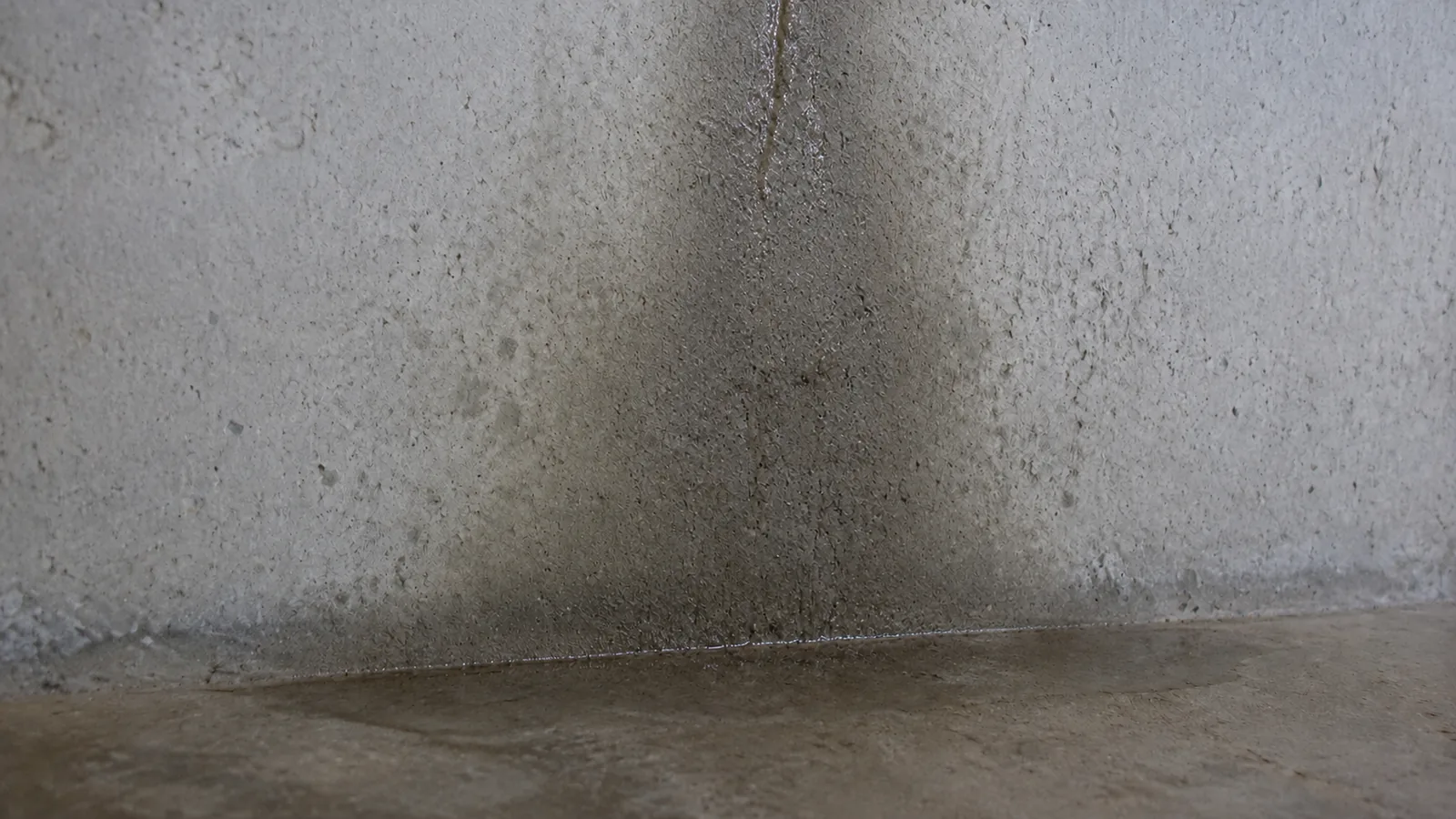
Seepage is different from a leak, and the difference is worth getting straight before anyone quotes you. A leak has a source you can point at — a crack, a pipe penetration, a gap at a window. Seepage is water moving through the body of the wall itself, so it shows up as a darkened area that spreads rather than a stream that runs. It usually appears low down, often at the same height as the outside soil is wet to, and it comes and goes with the weather.
What is happening inside the wall
Concrete and mortar are porous. Under ordinary conditions that porosity does nothing, because there is no water outside pressing to get in. When the soil against the wall saturates, the water in it has weight, and that weight drives moisture into every capillary path the material offers. Below grade there is no drying face on the outside, so the only direction it can leave is inward, into your basement.
Kalamazoo’s ground decides how bad this gets, street by street. Where the soil is glacial outwash sand and gravel, water arrives fast, presses hard for a short while and drains. Where there are bands of clay till, water stays against the wall for days after a storm and the clay swells while it holds it. In the Kalamazoo River valley and the lower-lying neighbourhoods the water table sits high to begin with and rises seasonally, which is why a wall that has been fine for years can start weeping in the spring after a heavy-snow winter.
Block walls and poured walls seep differently
A concrete block wall is hollow. Water that gets past the outside face does not stop at the face — it runs down inside the cores and fills them, and a block cavity can hold a surprising volume. It then finds its way out wherever the inside face is weakest: through mortar joints, through the block itself, and very commonly along the bottom course at the floor. If your damp patch is a horizontal band along one or two courses, or a chalky white bloom along the mortar lines, you are looking at a block wall with water standing in it.
A poured concrete wall is solid, so seepage through the body of it is less common. When a poured wall shows damp, it is usually at a specific defect: a form tie hole where the plug has failed, a cold joint where one pour met another, or a fine crack that is wetting the surrounding concrete rather than running. If you can trace the damp back to a line or a small round mark, that is a leak with a fixable source, and our leaking basement wall page covers those.
The cheap explanation you should rule out first
Not all damp on a basement wall came from outside. In a Michigan summer, warm humid air meets a wall that is still holding winter ground temperature and condenses on it, exactly the way a cold glass sweats. Basements here are heated storage or living space rather than vented crawl spaces, so this happens more than people expect.
The test takes a day and costs nothing. Tape a square of plastic sheet tightly to the wall on all four edges and leave it. Water on the room side is condensation, and a dehumidifier and some ventilation are the whole answer. Water on the wall side is seepage through the masonry, and no dehumidifier will stop it.
How worried you should be
Seepage rarely means the wall is failing. It is a water management problem, not a structural one, and by itself it does not threaten the house. If it happens once in a decade after an extraordinary storm, dry it out and get on with your life.
Two things move it up the list. The first is that the wall never dries, because permanently damp masonry in a heated basement feeds the mold that produces that musty smell and slowly destroys anything stored against it. The second is freeze-thaw. Water sitting in mortar joints through a Kalamazoo winter freezes and expands, and repeated cycles crumble mortar and spall the face off block. That is how a damp wall becomes a deteriorating wall over a decade.
The white crusty deposit is efflorescence — mineral salts left behind as water evaporates out of the masonry. It is harmless in itself, but it is proof that water is moving through the wall, not just condensing on it.
What fixes it and roughly what it costs
Start outside, because the cheapest version is real. Downspouts discharging at the foundation and ground that has settled into a back-slope toward the house put far more water against a wall than most people believe, and correcting both commonly costs a few hundred dollars to a couple of thousand. It is worth doing before anything else even when it turns out not to be enough.
When water is genuinely coming through the wall below grade, the standard remedy is interior basement waterproofing — a drainage channel cut in at the footing, connected to a sump, with the wall face drained into it so water is collected and pumped away instead of being asked not to arrive. On a block wall the cores are usually weep-drilled at the bottom course so the water standing inside can escape into the drain rather than through the face. A full perimeter system with a sump commonly runs $8,000–$15,000 here, less for a single wall. Interior coatings and paints on their own are the thing to be sceptical of; against real hydrostatic pressure they fail, and they hide the evidence while they do it.
Ranges and what moves them are on the cost page. If your basement is dry today, run the plastic-sheet test now and photograph the wall next time it rains hard — knowing whether the damp arrives in an hour or in two days is half the diagnosis.