
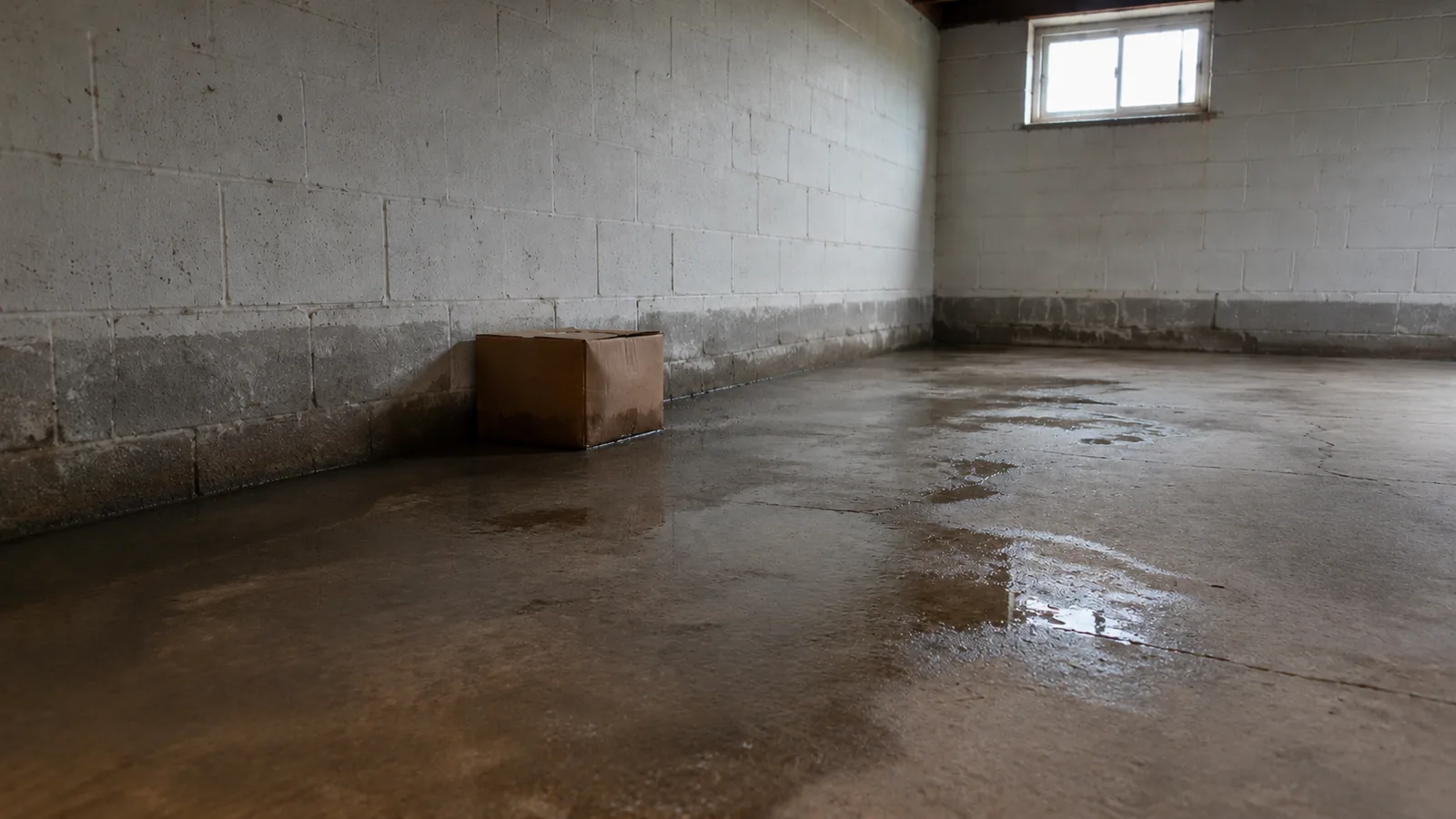
Water does not soak through a foundation wall the way it soaks through a sponge. It arrives by a route — a joint, a crack, a gap around a pipe, a window well, a failed pump. Concrete and block are porous enough to pass damp, but a puddle on the floor means bulk water has found an actual opening. The first useful thing you can do is work out where the route is, because the answer separates a few hundred dollars of outside work from five figures of interior drainage, and nobody can tell you which one you have without looking at the pattern.
What is actually pushing the water in
Soil around a foundation absorbs rain and snowmelt. When it saturates, the water in it has weight, and that weight presses sideways and upward against the wall and the slab. That is hydrostatic pressure, and it is not subtle — a saturated column of soil against a basement wall exerts hundreds of pounds per square foot. It does not create openings on its own. It finds the ones already there and drives water through them.
Kalamazoo makes this worse in two specific ways. The ground here is glacial: bands of outwash sand and gravel in some streets, clay till in others, sometimes both in one lot. Sand drains quickly but delivers water to the foundation quickly too; clay holds it against the wall for days and swells while it does. Then there is the calendar. Frozen ground stops absorbing, so when the thaw arrives with snowmelt and spring rain on top of it, everything moves at once and the water table in the river valley and the low-lying neighbourhoods comes up with it. March through May is when most basements here show what they have been hiding.
Reading where it came in
Walk the perimeter before you mop, and photograph the stain lines. They are evidence and they disappear the moment you clean up.
Water sitting in a line all the way along the joint where the wall meets the floor is the cove joint, and it means water is under the slab and coming up around the footing. That is the classic hydrostatic pattern and the one that usually points at drainage rather than a patch.
Water at a single spot on the wall, tracking down from a visible line, is a crack — and a crack that only weeps is a much smaller problem than it looks. Wet block that darkens in a band rather than running from one point is a different mechanism again, covered on our page about water seeping through a basement wall.
Water below a window well, or a stain fanning out from one corner near a downspout, is surface water. Water appearing within an hour of heavy rain is nearly always surface water too. Water arriving two days after the rain stopped, or during a February thaw with no rain at all, is groundwater.
And water near the sump basin with a pump in it is a pump question first. Lift the lid and pour a bucket in. If it does not run, you have a $400–$1,200 problem, not a $12,000 one.
How worried to be, honestly
A good share of what floods Kalamazoo basements is fixed outside the house for a few hundred dollars. Downspouts dumping at the wall instead of six or eight feet out, soil that has settled over the years into a slope running back toward the house, a window well with no drain and a lid full of leaves, a patio shedding toward the foundation. Any contractor who walks past all of that and quotes you interior drainage on the first visit is not doing you a service. Ask them what they found outside.
Check the plumbing too, before you spend anything. A weeping water heater, a split washing machine hose, a blocked furnace condensate line and a failed ejector pit all produce water on a floor that looks exactly like groundwater and is not.
The genuinely expensive version is the one that repeats: water at the cove joint every spring, or after every serious rain, in more than one part of the perimeter. That is a drainage failure — either the original footing drain has silted up and stopped working, or the house never had one. It will not settle down on its own, and it is worth acting on before finished walls, flooring and stored belongings start absorbing the cost each year.
What it costs to fix
Outside corrections — extending downspouts, regrading, a window well drain — commonly run from a couple of hundred dollars to about $2,000. A sump pump replaced is usually $400–$1,200 installed. A single injected crack is commonly $400–$900. An interior perimeter drain with a sump, which is the standard answer to repeated hydrostatic flooding, is commonly $8,000–$15,000 on a typical house here. Full exterior excavation and membrane is $15,000–$30,000 and up, and it is the right answer far less often than it is sold. These are market ranges, not quotes; the variables are perimeter length, wall type, access, and whether the floor has to come up.
Our basement waterproofing page sets out how those approaches differ and when each is justified, and there is a fuller breakdown of the numbers on the cost page.
What to do this week
If water is anywhere near outlets, the furnace or the panel, kill the circuits at the breaker before you go in. Get stored items off the floor and onto shelving. Photograph the water line on the wall, note how long after the rain it appeared, and check the sump. Then get someone to look at it in daylight, ideally while the ground is still wet — a dry basement in August tells a contractor far less than a damp one in April.