
“Waterproofing” is not one job. It is at least three, they cost wildly different amounts, and they solve different problems. One of them keeps water away from the house before it ever reaches the foundation. One of them manages water that has already arrived at the wall and gets it back out. One of them seals a specific opening that water is coming through. A contractor who installs interior drainage for a living will tend to describe waterproofing as interior drainage, and a contractor who digs will describe it as digging. Neither is lying. But the result is that homeowners are routinely quoted the most expensive of the three for a problem the cheapest one would have fixed.
This page exists to sort that out before you take a quote.
The cheap job: keeping water away from the foundation
Surface water management. Downspout extensions, regrading the six or eight feet of ground next to the wall so it falls away from the house, fixing a window well that has no drain and fills like a bucket, redirecting a driveway or patio that sheds toward the foundation.
This is the commonest cause of a wet Kalamazoo basement and it is by a wide margin the cheapest to fix. A roof sheds a startling volume of water into a downspout, and a downspout that ends in a splash block eighteen inches from the wall is putting all of it directly into the soil against your foundation, where it soaks down to footing level and finds its way in. Extending that discharge ten feet costs very little. Regrading a stretch of ground costs a few hundred dollars. Any contractor who does not walk the outside of the house before quoting you interior drainage is not doing you a service.
The structural-scale job: drainage
If water is arriving at the wall regardless of what you do outside — a high water table in the valley, saturated clay till holding water against the block, spring thaw — then the answer is a drainage system that collects it and pumps it out. There are two ways to do that.
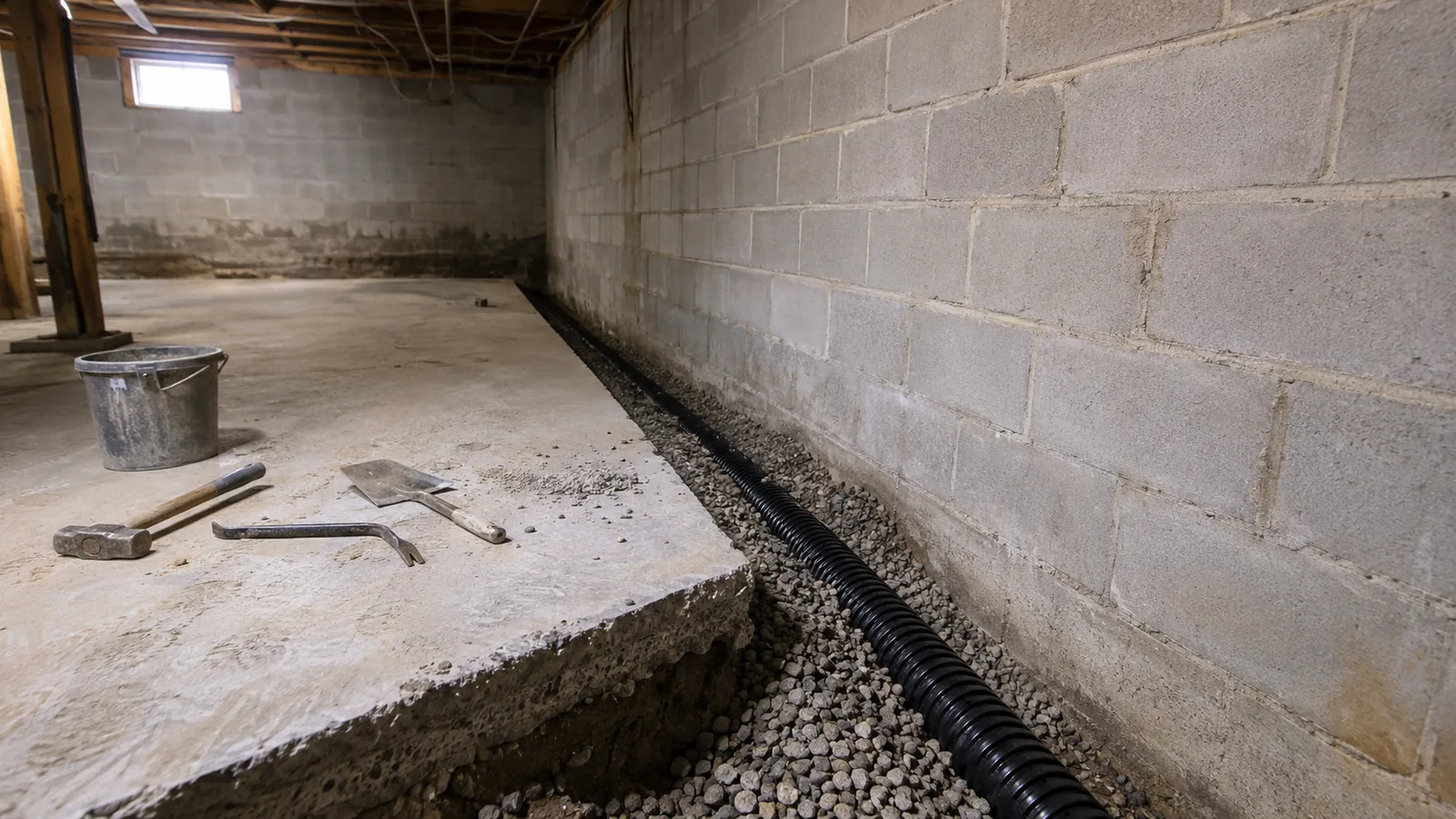
Interior drainage breaks out the perimeter of the slab, lays perforated pipe in stone alongside the footing, and routes it to a sump pit. It works from inside, does not touch your yard, and costs roughly half of the alternative. It does not stop water reaching the wall; it stops water staying in the basement.
Exterior waterproofing excavates down the outside of the wall to the footing, cleans it, applies a membrane, and installs a new footing drain in stone. It actually stops the water at the wall. It costs two to three times as much and it destroys landscaping.
Either one depends on a working sump pump, because both are collection systems and neither has anywhere to send the water without one.
The narrow job: sealing an opening
Sometimes water is not arriving everywhere. It is arriving at one place, and you can see where. A vertical crack in a poured wall, a form tie rod hole that has rusted out, a gap where the water service pipe passes through the wall. That is a sealing job, not a drainage job, and it is measured in hundreds of dollars rather than thousands. See foundation crack repair for how injection works and when it is the right call.
How to tell which one you have
Timing and location tell you most of it, and you can do this part yourself before anyone visits.
Water that shows up during heavy rain, at one spot, near a downspout or a window well, and dries up within a day, is almost always a surface water problem. Water that appears along the joint where the floor meets the wall, in several places, in March or April when the ground is thawing and the water table is up, is hydrostatic pressure and it is a drainage problem. A single defined stream running down the face of a poured wall from a visible crack is a sealing problem. Damp that never quite becomes water, with a smell attached, is often a humidity and ventilation problem rather than a leak at all.
If you are not sure which of those you are looking at, the water in the basement page walks through the diagnosis in more detail.
When you do not need any of this
If your gutters are blocked, clear them. If your downspouts discharge at the wall, extend them and wait for the next serious rain before spending anything else. If the ground next to the house has settled into a trench that holds water — very common on houses fifteen or twenty years past backfill, because backfill keeps compacting for decades — fix the grade first.
We are not being modest. This sequence saves people five figures often enough that skipping it is the single most expensive mistake in this trade. Interior drainage will not stop working if you do the cheap things first, and if the cheap things fix it, you have saved the price of a car.
What it costs in this market
A full interior perimeter drain with a sump commonly runs $8,000 to $15,000 on an average Kalamazoo house, driven by linear feet of wall, whether the slab is thick, and how much is stored in the way. Exterior excavation and membrane commonly runs $15,000 to $30,000 and up, with depth and access dominating everything else. Crack injection is usually $400 to $900 per crack. A sump pump replacement is $400 to $1,200 installed. Grading and downspout work is generally a few hundred. The cost page breaks down what moves each of those numbers.
What to ask before you sign
Ask what the contractor thinks the water source is, and make them answer in terms of a mechanism rather than a product. Ask whether they walked the exterior. Ask what happens to the water once it is collected and where the discharge terminates. Ask whether the warranty covers the wall staying dry or only the system running, because those are very different promises. And ask what they would do if the cheap fix was tried first and failed — a contractor who has a sensible answer to that is one who has thought about your house rather than their invoice.