
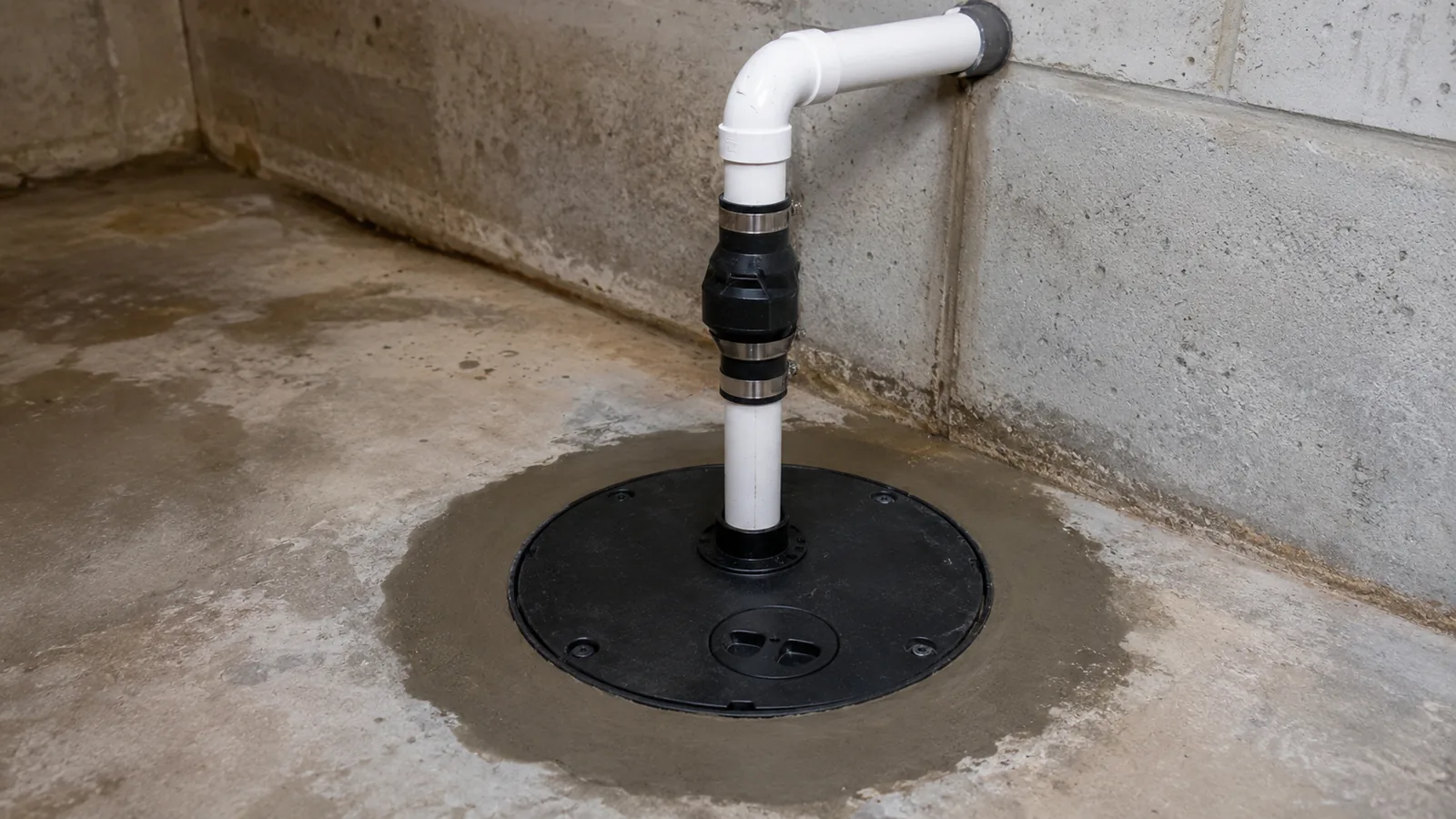
A sump pump is a pit, a pump, a float switch, a check valve and a pipe to the outside. That is the entire machine. Almost everything that goes wrong with one is a decision made at installation rather than a defect in the pump, which is why it is worth understanding the four choices that matter: how big the pit is, how big the pump is, where the water goes, and what happens when the power stops.
The pump itself is the cheap part.
When a house needs one
Any basement with a perimeter drain needs one, because a drain with nowhere to send water is a trench. If you are having interior drainage installed the pump comes with it and there is no separate decision to make.
Beyond that, a pit and pump are worth installing on their own if the water table in your neighborhood comes up in spring and pushes water through the floor-wall joint, which in the Kalamazoo River valley and the low-lying streets around it is a normal seasonal event rather than a fault. A pump gives that water somewhere to go before it reaches the slab.
When you do not need one
If your basement floods once a year through a window well, a sump pump is the wrong machine. Fix the well: a proper drain in the bottom connected to the footing drain, or a cover. If water arrives at one wall after heavy rain and there is a downspout discharging beside it, you are pumping out water you could simply have moved ten feet away for the price of a length of pipe.
And a pump does nothing at all for a wall that leaks above floor level. Water coming through a crack halfway up a poured wall runs down and across the floor to the pit, which means you have a wet floor and a running pump instead of a dry basement. That is a sealing job — see foundation crack repair — and the water in the basement page helps sort out which pattern you have.
Sizing, honestly
Most residential basements are correctly served by a one-third or one-half horsepower pump. Bigger is not better. An oversized pump empties the pit in seconds, shuts off, refills, and starts again, and that short-cycling is what kills switches and burns motors. What actually matters is head — the vertical lift from the pit to the discharge — because a pump rated at 3,000 gallons an hour at zero lift may move barely half that at ten feet of head plus a long horizontal run. Ask for the flow at your actual lift, not the number on the box.
Pit size matters more than people expect. A pit that is too small forces cycling no matter what pump is in it; eighteen inches across and twenty-two to twenty-four deep is a sensible minimum. A cast iron body runs cooler and lasts longer than an all-plastic one, and a vertical float avoids the classic failure of a tethered float hanging up on the pit wall.
Discharge, which is where installations go wrong
The discharge line leaves the pump, passes a check valve — which stops the column of water in the pipe falling back into the pit each time the pump stops, and prevents the pump restarting on its own backwash — and exits the wall.
Where it goes after that is the part that gets rushed. It must terminate far enough from the house that the water does not soak straight back down to the footing and return to the pit — ten feet is a reasonable minimum, further if the ground falls back toward the house. It must not discharge onto a walk or driveway, where in December it becomes ice. And in most municipalities it must not go into the sanitary sewer, so if someone proposes tying it into a floor drain, ask.
Freeze-proof discharge in a Michigan winter
This is the local problem and it is a real one. A discharge line that runs above ground and downhill for twenty feet will hold a slug of water at its low end, that slug freezes in January, and the next time the pump runs it is pushing against a plug of ice. The pump does not know that. It runs against the blockage, overheats, and either trips or fails — during a thaw, which is exactly when you need it.
The fixes are ordinary. Run the buried section below frost depth, which around here means roughly forty-two inches, and slope it continuously so nothing stands in it. Where the line has to surface, oversize the last section and leave the outlet open so it cannot cap over with ice. Fit a freeze-relief fitting near the exterior wall, which gives the pump somewhere to dump if the main line blocks. Some houses simply disconnect the above-ground extension for winter and accept a shorter discharge until spring; it is inelegant and it works.
Battery backup, and why it is not an upsell
The storm that fills your basement is very often the same storm that brings a line down. Straight-line winds, a heavy wet snow, an April thunderstorm — the water table is at its peak and the pump has no electricity. A primary pump with no backup is a system that is guaranteed to be offline at the worst hour of the year.
A battery backup is a second pump on its own float, sitting slightly higher in the pit, running off a deep-cycle battery through an inverter. It will typically carry a house through several hours of moderate inflow, less if the inflow is heavy. It is not a generator and should not be sold as one. A water-powered backup, driven by municipal supply pressure, runs indefinitely but wastes water and is useless on a well.
What it costs here
A pump replacement in an existing pit commonly runs $400 to $1,200 installed. A new pit cut into an existing slab, with pump, check valve and discharge, is usually $1,200 to $3,000. A battery backup commonly adds $800 to $2,000. Trenching a discharge below frost depth is priced by the foot and by what is in the way. If the pump is part of a full perimeter system it is folded into that price — the cost page has the wider figures.
What to ask before you sign
Ask for the pump’s flow rate at your actual head, not the headline number. Ask what the switch type is and why. Ask where the discharge terminates, how deep it is buried, and what happens to it in a freeze. Ask whether a check valve is included and whether it is serviceable without cutting pipe. Ask what the backup will run for at a realistic inflow. And ask what testing and service looks like — the sump pump repair page covers what fails and how you spot it early.