
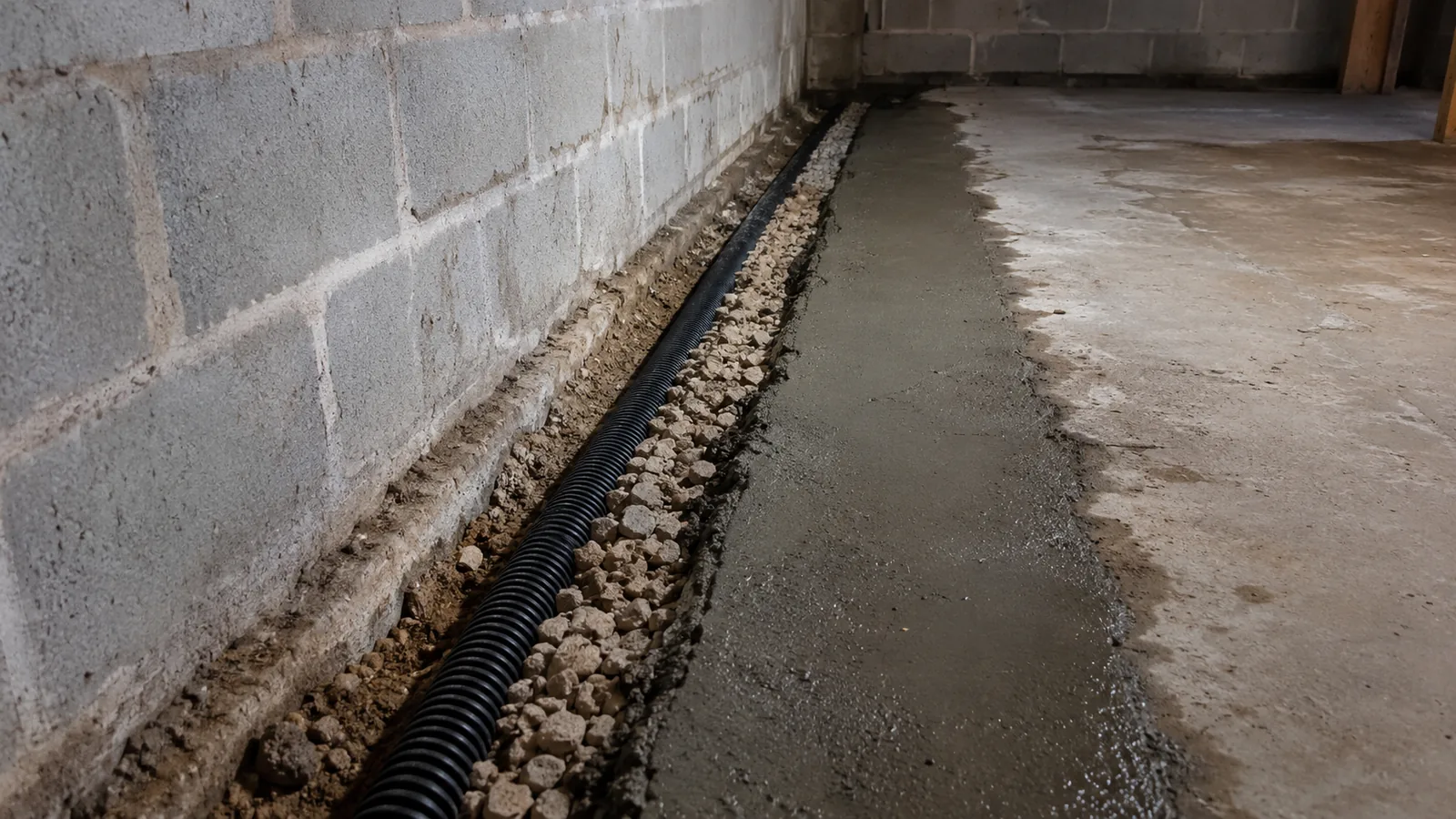
Interior waterproofing is a drainage system installed from inside the basement. The perimeter of the concrete slab is broken out, perforated pipe is bedded in washed stone next to the footing, and everything the pipe collects is carried to a sump pit and pumped outside. Nobody digs up the yard. Nobody touches the landscaping. The work happens entirely within the walls of the house, which is why it costs roughly half of what exterior work costs and why it can be done in February when the ground outside is frozen solid.
It is also, and this matters, a system that manages water rather than stopping it. Understanding that distinction is the whole decision.
What it does and does not do
Water still reaches the outside face of your foundation wall. It still soaks into porous block. In a block wall it still fills the hollow cores. What interior drainage does is give that water a controlled route out at the bottom, before it can rise into the room, and a pump to lift it away from the house. The wall stays damp. The basement stays dry.
For a great many Kalamazoo houses that is exactly the correct trade. If the problem is hydrostatic pressure — water table rising in spring, saturated clay till holding water against the wall, snowmelt and April rain arriving in the same fortnight — then the water is coming from below and around, and no amount of coating the inside of the wall will hold it back. Collecting it and pumping it out is the honest engineering answer.
Where it falls short is when the wall itself cannot tolerate being wet. A block wall that is deteriorating, a stone foundation losing its mortar, or a wall that is bowing under hydraulic and soil pressure is not helped much by keeping the floor dry. That is when digging outside starts to earn its price, because relieving pressure on the outside of the wall is something interior work simply cannot do.
When you do not need this
Interior drainage is oversold. If your water shows up only after heavy rain, only in one corner, and there is a downspout discharging within a couple of feet of that corner, you have a surface water problem and a $12,000 system is the wrong answer to it. Extend the downspout, fix the grade, watch it through one real storm. The same goes for a single leaking crack in a poured wall — that is an injection job, described on the foundation crack repair page, not a reason to break out your floor.
The test that separates the two is honest and simple. Does the water appear at the floor-wall joint, in more than one place, and does it correlate with the season more than with any single storm? That is a drainage problem. Does it appear at one point, quickly, after a specific downpour? Look outside first. The water in the basement page goes through this in more detail.
How the work is actually done
A crew arrives and moves everything off the perimeter, then sheets off the work area, because breaking concrete produces a remarkable quantity of dust.
They cut and break out a channel of slab around the inside perimeter, typically twelve to eighteen inches wide, down to the soil beside the footing. On a block wall a good crew will also drill weep holes into the bottom course of block, so that water sitting inside the hollow cores can drain into the new system instead of eventually finding the mortar joint. This step is skipped surprisingly often and it is the difference between a system that drains the wall and one that only drains the floor.
Perforated pipe goes in, wrapped or bedded in washed stone rather than pea gravel or the spoil that just came out, and pitched toward the sump location. A vapor barrier or dimpled membrane is usually run down the wall face and lapped into the channel, so that water running down the inside of the wall is directed into the drain rather than onto the floor.
The sump pit is dug, set, and the pipe run into it. The pump is installed, plumbed with a check valve, and the discharge routed outside. Then the channel is backfilled with stone and the slab is patched with new concrete.
On a typical house this is two to four days. It is loud, it is dusty, and you should expect the basement to be unusable for the week.
What it costs here
In this market a full perimeter interior system with a sump commonly falls between $8,000 and $15,000. Partial runs — one wall, or two — are proportionally less and are sometimes entirely appropriate if the water only ever appears on the uphill side of the house.
The number moves on linear feet, first and most. After that: slab thickness, whether there is a footing that projects into the trench, whether the basement is finished and walls have to come out, whether there is an interior bearing wall footing in the way, access for hauling out spoil, and whether the discharge run outside is short or long. A finished basement can easily add several thousand before a single hole is drilled. See the cost page for how these stack up.
What to ask before you sign
Ask whether they drill weep holes in block walls, and if not, why not. Ask what the pipe is bedded in and insist on washed stone. Ask where the sump discharge terminates, because a discharge that dumps against the foundation ten feet away has simply built you a very expensive loop — and ask specifically how it is protected against freezing, which the sump pump installation page covers.
Ask what happens in a power cut, since the storm that floods your basement is the same storm that takes the power out. Ask whether the warranty is on the system or on the basement staying dry, and get the answer in writing. And ask them to tell you plainly why they are recommending interior rather than exterior work on your particular house. A contractor who can articulate the trade-off has thought about it. One who cannot has only one product to sell.