
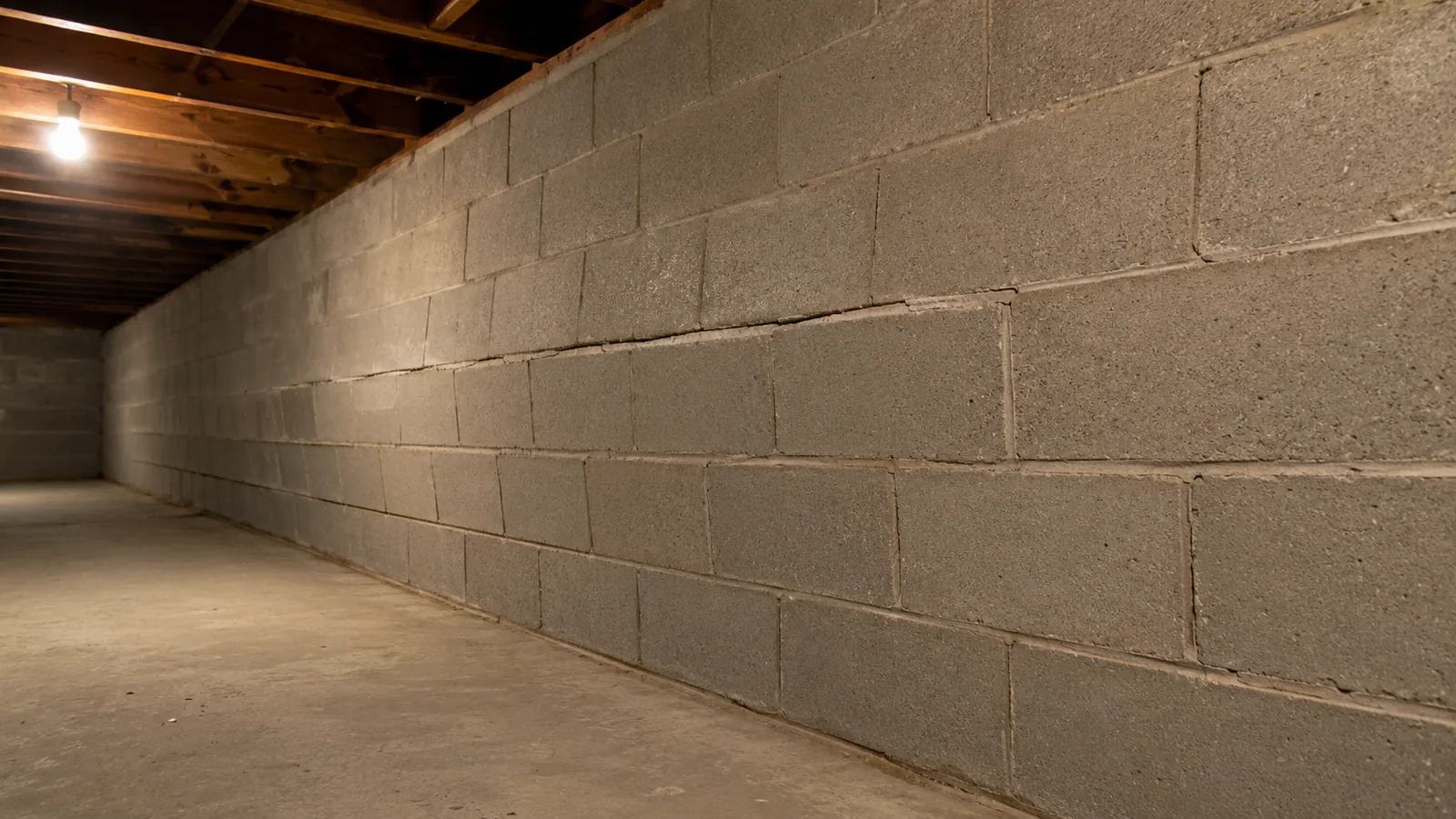
This is one of the few basement problems that is exactly as serious as it looks. A wall bowing inward is not settling, not cosmetic cracking and not a water problem — it is losing a structural argument with the soil outside, and it will keep losing until something changes. Most pages on this site carry a paragraph about when to leave things alone. This one does not.
What a basement wall is being asked to do
Your foundation wall is a retaining wall. It holds back several feet of soil by spanning vertically between two restraints: the floor slab at the bottom and the floor framing of the house at the top. Between those points it resists the soil pushing sideways. Push harder than it can carry and it deflects inward, and where it deflects most it eventually cracks.
Unreinforced concrete block, which much of Kalamazoo’s older housing stock is built from, has almost no capacity to resist that bending. It fails at a mortar bed joint, usually three to five courses up from the floor, and the wall then hinges about that joint with the upper part tipping into the room. Stone and rubble walls bulge instead, as the mortar loses its grip and individual stones move relative to one another. Poured concrete resists bending far better, so a poured wall that is visibly out of plumb has been under serious sustained load and should not be discounted for lacking an obvious crack.
There is a second failure mode. Sometimes the wall does not bend at all — the top course slides inward, sheared off at the joint under the sill plate, because the floor framing was never properly tied to the top of the wall. That looks like a step rather than a curve, and it is not less serious for being tidier.
What is doing the pushing
Wet soil. Saturated ground weighs far more than dry ground, and the clay till that runs in bands through this glacial terrain swells as it takes water on, adding pressure on top of the weight. A wall that stood for decades against soil that drained can be overloaded once the drainage stops working.
Frost contributes. Southern Michigan’s code frost depth is around 42 inches, so the upper three and a half feet of soil against your wall can freeze solid in a hard winter and expand against it. And where a crack has opened, freeze-thaw enlarges it — water enters, freezes, expands, widens the gap, thaws, takes on more water, over and over between November and April.
Then there are the avoidable loads: downspouts discharging into the backfill, a parking area against the wall where vehicles add surcharge, a large tree close in, backfill dumped and never compacted.
Measuring it, which is the only way to know
Hold a long straight edge or a plumb line against the wall from the sill plate down to the floor and measure the largest gap between the line and the wall. That deflection number matters more than crack width, and it is what any competent contractor will take first.
Under about an inch, the wall is early in the process. It is very likely repairable in place with reinforcement, and repairing it now is dramatically cheaper than repairing it in five years.
Between one and two inches, the wall has moved meaningfully. Expect an open horizontal crack, mortar crumbling from the joint, and stepped cracking running up toward the corners. It needs structural reinforcement rather than monitoring, and the water driving it needs addressing at the same time.
Beyond about two inches, or where the top course has slid, or mortar is crushed at the sill, or you can see soil or daylight through a joint — treat this as urgent. Walls in that condition can fail without much warning, and they typically fail when the ground is saturated, which here means March through May. Stop stacking anything against it and get an engineer or a foundation contractor out.
If you are not sure whether the wall is bowing or simply cracked, the companion page on a horizontal crack in a basement wall covers the same failure at the stage where the crack has appeared but the movement is not yet obvious.
Things not to do while you decide
Do not add soil against the outside of that wall, and do not park a vehicle beside it. Do not frame and drywall over it — finishing hides exactly the evidence you need. Do not fill the crack with hydraulic cement and consider it handled; sealing a crack does nothing about the load that opened it. And do not let anyone excavate outside a bowing wall without bracing it from the inside first, because removing the soil from one face of a wall partly held by that soil is how a wall comes down.
What repair costs, and what can honestly be promised
Carbon fiber straps bonded to the inside face and anchored to slab and framing are the usual answer for walls under roughly two inches of deflection, commonly $600–$1,000 per strap at four to five feet apart — a few thousand dollars for a single wall. They stop further movement; they do not straighten anything.
Steel I-beams braced to joists and slab cost broadly similar per bay and handle more deflection. Helical tiebacks and wall anchors, which reach out into undisturbed soil beyond the backfill, cost more and are the only common method that recovers some of the movement over time. Nobody can promise a wall will come back to plumb, and be wary of anyone who does.
Where a block wall has gone too far, the honest answer is excavation and rebuilding, which runs into the tens of thousands. That is why acting early is not a sales line here: the gap between a strapped wall and a rebuilt one is the largest price difference on this site.
Whatever holds the wall must be paired with getting the water away from it, or the pressure returns. Our basement wall repair page explains how each method is chosen, and the cost page sets out what moves the numbers.