
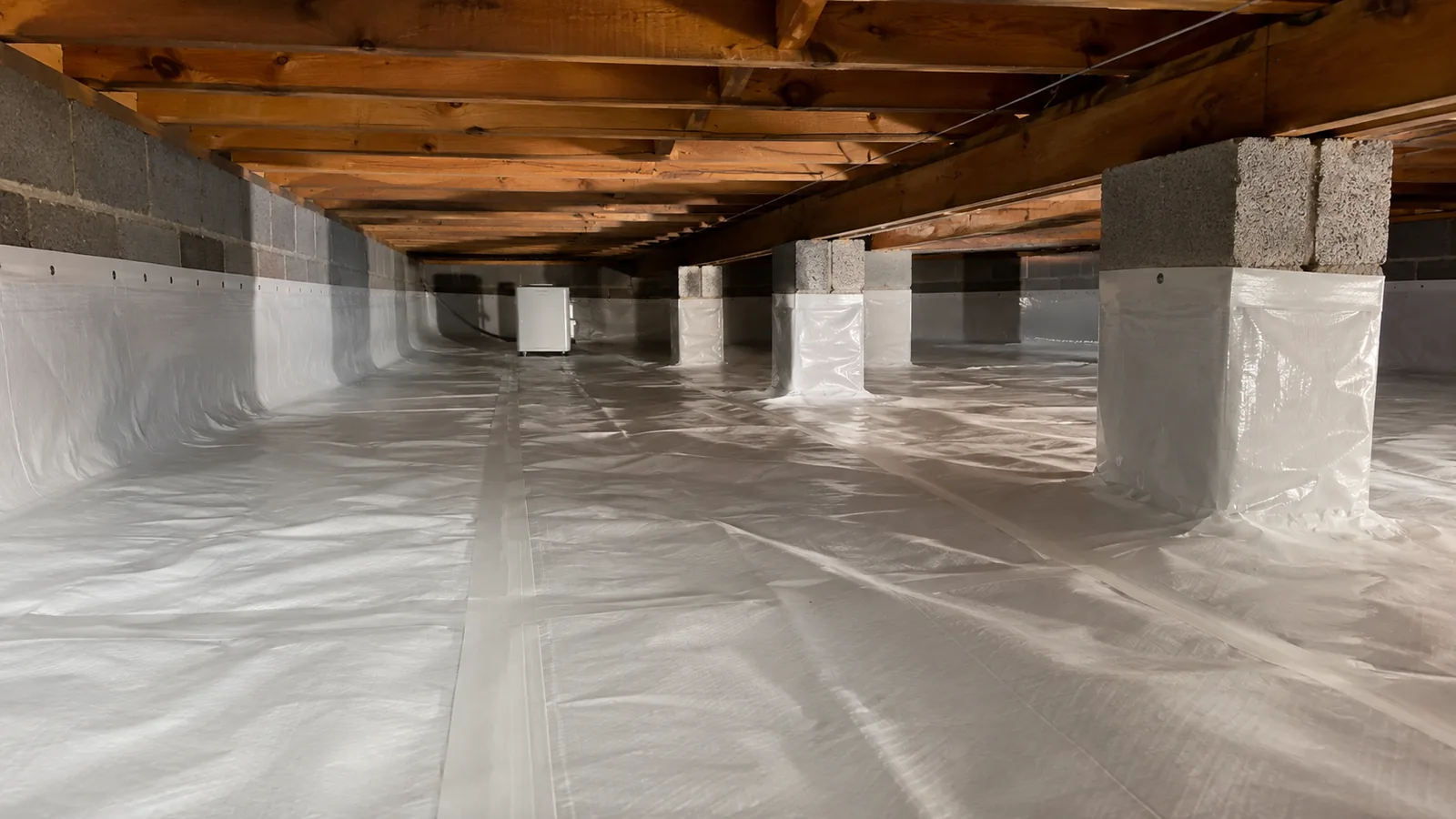
Most houses in this town have full basements, and that is not an accident. Southern Michigan’s code frost depth is around 42 inches, so a footing has to go down more than three and a half feet regardless of what you build on top of it. Once the excavator is that deep, going the rest of the way to a full basement is barely more work — a few more feet of wall and a slab — and you get a whole floor of house for it. That is why basements are near-universal here and why crawl spaces are common in the South and comparatively rare in Kalamazoo.
But some houses have them. Additions built on shallow foundations, older cottages around the lakes, a few post-war builds, and houses where a sloping lot left one section too shallow to dig. If you have one, this page is for you. If you have a basement, this is the wrong page — try basement waterproofing instead.
What encapsulation is
A sealed liner. A heavy polyethylene sheet, typically 12 to 20 mil, laid over the entire dirt floor, run up the foundation walls and mechanically fastened and sealed to them, with every seam taped and every pier wrapped. The exterior vents are closed and sealed. The crawl space stops being outdoor space that happens to sit under your house and becomes part of the building’s conditioned envelope.
It is a different idea from the old approach, which was to vent a crawl space so that outside air would carry moisture away. In this climate that logic runs backwards for half the year. In July, warm humid outside air enters a crawl space at ground temperature and condenses on every cool surface in it. The venting is actively wetting the space it was supposed to dry.
What it fixes, and what it does not
The honest promise is humidity control, and that is a real one. A sealed and dehumidified crawl space runs at a stable relative humidity, which means joists and subfloor stop taking on moisture, fasteners stop corroding, and the conditions that support mold growth are no longer present. Floors above are warmer in winter, and the musty smell that migrates up through the floor — because air moves from the crawl space into the house whether you want it to or not — goes away. If that smell is what brought you here, the musty smell in the basement page covers the same mechanism.
What it does not do is make a crawl space permanently mold-free by itself. Existing growth on joists has to be cleaned or treated before the liner goes down, or you have sealed it in. And the space needs to stay dry afterwards, which means a dehumidifier that is running and maintained. Encapsulation is a system, not a coat of paint.
It also does not fix standing water. A liner over saturated ground is a liner floating on water.
When you do not need this
Standing water in a crawl space is very often a surface problem and the fix is outside, for a few hundred dollars. Downspouts discharging beside the foundation, ground sloping back toward the house, a patio or drive shedding toward the vents. A meaningful share of the water we are called about is solved out there, and any contractor who quotes encapsulation without walking the exterior first is not doing you a service.
If the crawl space is dry, has an intact vapor barrier already, and reads at a sensible humidity on a cheap hygrometer through August, you do not need to spend anything. Buy the hygrometer, leave it down there, and look at it in July. That is a $15 diagnostic that saves people thousands.
And if the real complaint is a cold floor over a crawl space that is otherwise dry, insulating the walls or the floor above may be the whole answer at a fraction of the price.
How the work is done
Everything comes out first. Old torn barrier, debris, construction leavings. Standing water is dealt with and the ground is graded roughly level where it is not.
If there is a water source, it is addressed before anything else. That may be exterior grading, or a perimeter drain around the inside of the crawl space footing routed to a sump — the same principle as interior basement drainage, at a smaller scale. A crawl space sump needs the same attention to discharge routing and freeze protection as any other, which the sump pump installation page covers.
Any wood with active growth is cleaned and treated at this stage, while there is access.
The liner goes down: overlapped generously at the seams, taped, run up the walls to within a few inches of the sill, and terminated with a mechanical fastener and sealant rather than tape alone, which lets go over time. Piers are wrapped individually. The termination is left short of the sill plate deliberately, so the wood remains visible for termite inspection.
Vents are sealed. Rim joists are usually insulated with rigid foam or closed-cell spray foam, since with the vents shut the crawl space wall becomes part of the thermal envelope and the rim is where most of the heat leaves.
Finally, conditioning. Either a dedicated crawl space dehumidifier draining to the sump or to the outside, or a supply of conditioned air from the house system where that is permitted. A sealed crawl space with no means of drying is a sealed damp crawl space.
What it costs here
In this market a full encapsulation commonly runs $5,000 to $12,000 for a typical crawl space, and the range is wide because crawl spaces are.
Square footage drives it. So does head height — a space you can crouch in costs far less to work in than an 18-inch clearance where everything is done lying down. Debris removal and any demolition of old barrier adds. Mold remediation before the liner is a separate line and should be quoted separately. Liner thickness matters, and 6-mil is not encapsulation. Drainage and a sump, if needed, commonly adds $2,000 to $5,000. A dehumidifier of the right capacity commonly runs $1,500 to $3,000 installed. The cost page has the wider set of figures.
What to ask before you sign
Ask what the liner thickness is and how it terminates at the wall — fastened and sealed, or taped. Ask whether the rim joist is insulated. Ask whether they found a water source and what they propose to do about it before the liner goes down, because a liner over an unaddressed leak is a lid on a puddle.
Ask what dehumidifier is specified, at what pint-per-day capacity, and where it drains. Ask what maintenance it needs and who does it. And ask them to leave the top few inches of wall exposed for inspection, because a contractor who covers the sill has made your next termite inspection somebody else’s problem.